
When is the Best Time to Book a Flight? Here's the Real Answer.

Stop guessing. Here’s when is the best time to book air flights for domestic and international trips, based on data and insider strategies, not myths.
Let's cut the nonsense: there's no magic, secret day to book a flight. The real key is the timing. For a domestic flight, you're looking for a sweet spot that opens up about 3-6 weeks before you fly. If you're heading overseas, think much further ahead—the best deals usually show up 3-5 months out. Forget the myth about booking at 2 AM on a Tuesday. The truth is, it's about when you look, not what time it is.
Is there a perfect time to book a flight?
Honestly, trying to pinpoint the absolute cheapest moment to book a flight feels a lot like playing the stock market. It's stressful, confusing, and there's no guarantee you'll win. But it's not as random as it seems.
Airlines use complex pricing algorithms designed to do one thing: make them the most money possible. Your job isn't to find a glitch in their system; it's to find the predictable sweet spot in their pricing model—that period before demand kicks in and sends the fares through the roof. This guide is your reality check, designed to bust the common travel myths and give you a simple, data-backed timeline you can actually use.
We’ll show you why booking way too early is just as bad as waiting until the last minute. A little foresight can save you a surprising amount of cash, freeing up your budget for what really matters on the trip itself.
Speaking of planning, if you're drowning in options, the best vacation planning apps can help you keep your sanity.
The infographic below paints a clear picture of these booking windows.
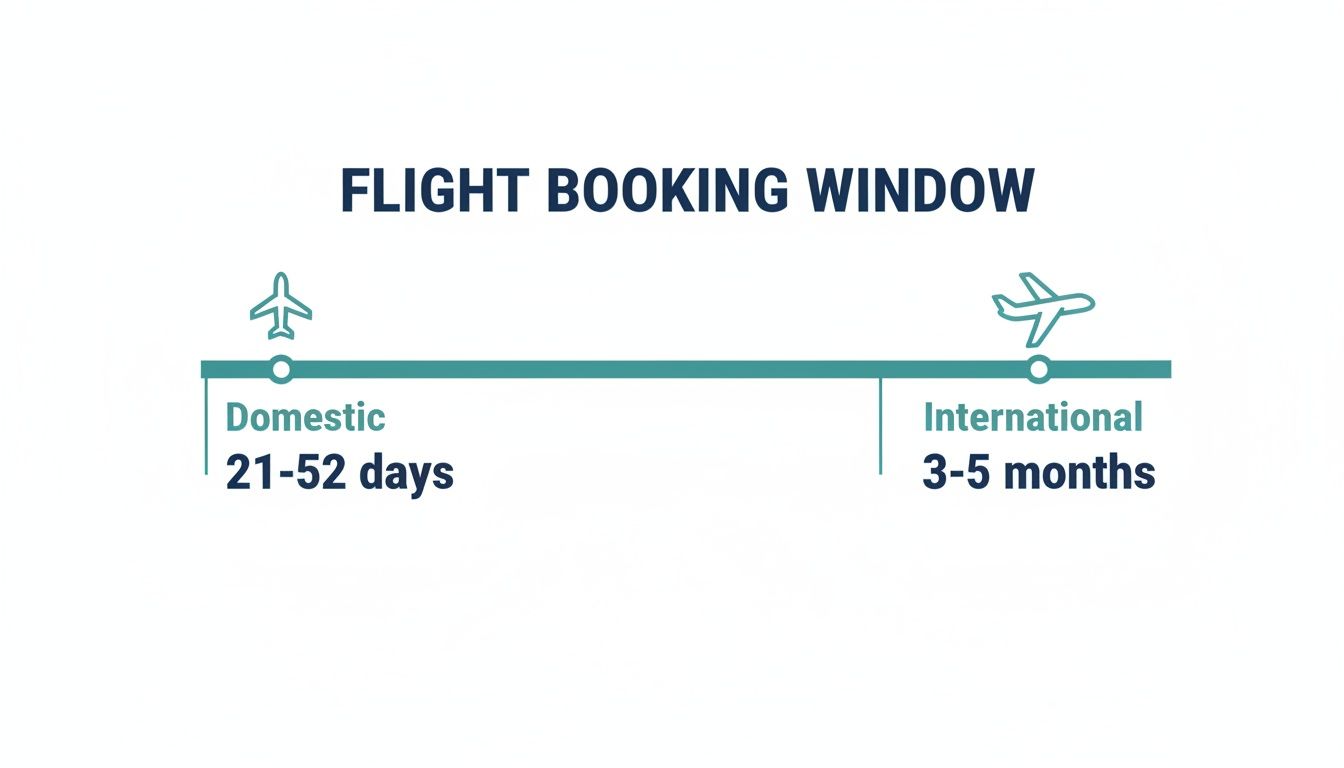
The main takeaway is that your timeline needs to adapt to where you're going. Now that you have the quick answer, let’s dig into why these windows exist and how you can make them work for you.
Why do flight prices feel so random?

Let's get one thing straight: airline pricing isn't random. It’s just designed to feel chaotic. You're not looking for a secret glitch. The goal is to understand the game you’re playing, which is called dynamic pricing.
Think of an airline seat like a carton of milk. It has a strict expiration date—the moment the plane takes off. The airline’s job is to sell every seat for the highest possible price before it "expires" and becomes worthless. This creates a high-stakes game of chicken between you and the airline. Last time I was booking a flight to Denver, I watched the price jump by $30 in the time it took me to walk across the room and grab my credit card. It’s not personal; it’s just the algorithm doing its thing.
What is "Yield Management"?
This whole process has a fancy name: yield management. It just means they're trying to squeeze every possible dollar out of a flight. Airlines use incredibly complex algorithms that constantly crunch dozens of data points to set the price you see.
These algorithms weigh several key inputs:
- Current Demand: How many people are searching for your exact route right now?
- Historical Data: How quickly did this same flight sell out last year?
- Competitor Prices: What are other airlines charging for a similar trip?
- Time of Year: Is it a holiday, spring break, or just a slow Tuesday in October?
Because these factors can change by the minute, the price of your flight can, too.
So how does that affect what I pay?
Picture it this way: each flight has several invisible "buckets" of seats, each with a different price tag. The first bucket holds the cheapest seats. Once those sell out, the system automatically starts selling from the next, slightly more expensive bucket. And so on.
The key takeaway is you're not competing against the airline; you're competing against other travelers for the limited seats in the cheapest buckets. When those are gone, they're gone for good.
This is why booking too early can backfire—the airline might not have even released its cheap promotional fares yet. But waiting too long is a much bigger gamble because you'll almost certainly be stuck with the last, most expensive seats reserved for desperate business travelers.
Understanding this system turns the chaos into a predictable pattern. It’s exactly this kind of decision fatigue that inspired us to build the WanderAssist 60-second planner, so you can focus on the trip, not the tedious planning.
What's the sweet spot for domestic US flights?
<iframe width="100%" style="aspect-ratio: 16 / 9;" src="https://www.youtube.com/embed/72hlr-E7KA0" frameborder="0" allow="autoplay; encrypted-media" allowfullscreen></iframe>When you're planning a trip inside the US, timing is everything. It's tempting to think there's some magic day to buy, but it's really about a strategic booking window. Book too early, and you miss the sales. Wait too long, and you're guaranteed to pay a premium.
Your goal is to hit that pricing "sweet spot"—the period when airlines are getting serious about filling seats but haven't started jacking up prices for the last-minute crowd.
What's the data-backed booking window?
So, what does the data actually say? For domestic trips, the sweet spot consistently falls between 3 to 6 weeks before you plan to fly. On average, the absolute lowest prices tend to pop up around 4-5 weeks out.
For example, if you're eyeing a spring break trip in March, you'll want to start booking in late January or early February. That puts you right in the zone. If you want to get into the weeds on this, you can explore more details about flight booking strategies.
I saw this play out perfectly last year on a trip to Austin. My friends, anxious to lock things down, booked their flights three months in advance. I held off, set a price alert, and waited. Sure enough, right around the 40-day mark, the price for the same flight dropped. I snagged it and saved over $150 compared to what they paid. It’s a classic case of how a little patience inside the right window pays off.
When does holiday travel change the rules?
These rules go right out the window for major holidays. For Thanksgiving, Christmas, or the Fourth of July, airlines know demand is a sure thing, and they price accordingly. For these peak travel times, the strategy is simple: book early.
- Thanksgiving: Start looking in August and book by early October at the absolute latest.
- Christmas/New Year's: The best deals are found in late summer, from August through September.
Waiting for a price drop on a holiday flight is a losing game. The cheapest seats are released early, and once they’re gone, prices only go one way: up.
The WanderAssist Reality Check
Price Warning: The idea of a last-minute deal on a domestic flight is a myth. Airlines know that last-minute bookers are often business travelers or people with emergencies who have no choice but to pay. Don't expect to find a bargain a week before your flight; you'll just be paying a steep "procrastination tax." This is exactly the kind of planning headache that tools like the WanderAssist 60-second planner are designed to solve.
How should I approach international travel planning?

Booking a flight across an ocean is a different beast entirely. The lead times are longer, the stakes are higher, and the price swings can be massive. For international travel, you need to think in months, not weeks.
Airlines are playing a complex game, juggling demand from multiple countries, coordinating with partner carriers, and navigating various peak seasons all at once. This means their pricing algorithms are chewing on way more data, which can make finding that perfect price feel like a guessing game.
What's the international booking window?
The data is surprisingly clear: you need to start your serious search and be ready to buy 3 to 5 months before your departure date.
Book any earlier, and you'll likely pay a premium for being too prepared. Airlines often haven't released their most competitive fares that far out. But if you wait until you're inside that three-month window, you're playing with fire. That's when prices typically begin a steep, steady climb.
I saw this firsthand planning a trip to Lisbon last year. I started looking six months out, and the fares were stubbornly high. I set a price alert and waited. Sure enough, just inside the five-month mark, a fare popped up that was almost $400 cheaper than anything I'd seen before. The friends who booked at six months out were kicking themselves.
Should I book on a specific day of the week?
You’ve probably heard the old advice to book your flight on a Tuesday to get the best deal. While there’s a grain of truth to it, fixating on the day of the week is like trying to pick the perfect leaf while ignoring the entire forest.
Some studies show booking on a Sunday could save you a little, and other analyses suggest strategic timing can knock fares down by as much as 36%. But here's the reality: those savings are pocket change compared to the massive price hikes you'll face by booking outside the crucial 3-5 month window. You can discover more insights on flight booking trends on The Points Guy.
Think of the "best day to book" as a tie-breaker, not your main strategy. If you find a great price within your ideal 3-5 month window on a Saturday, grab it. Don't risk losing the fare by waiting until Sunday just to save another $20. And remember, a long-haul flight can mess with your body clock. If you want to hit the ground running, check out our guide on how to fix jetlag like a seasoned traveler.
The WanderAssist Reality Check
Tourist Trap Alert: Be careful with those super-cheap international airlines. A rock-bottom base fare can easily double once you add fees for carry-on bags, checked luggage, choosing a seat, or even printing your boarding pass at the airport. Before you get excited about a deal, do the math. Sometimes, a major carrier's "more expensive" ticket is actually the cheaper and better option.
What tools and tactics actually work?
Enough theory. Let's get down to the tools and tactics you can use right now to stop overpaying for flights. This is your hands-on guide to becoming a smarter flight booker. Knowing when to book is half the battle. The other half is using the right tools to act on that knowledge without spending hours staring at your screen.
Let the deals come to you
The single most effective thing you can do is stop actively hunting and start passively tracking. Instead of manually checking prices every day, set up price alerts on a platform like Google Flights or Skyscanner. Just pop in your route and dates, and they’ll email you when the price changes. This lets the algorithms do the heavy lifting for you and removes the guesswork from the process.
Master the art of flexibility
If you have any wiggle room in your schedule, you hold a massive advantage. Sometimes shifting your travel dates by just one or two days can literally cut your airfare in half.
- Use the Calendar View: Most flight search engines have a calendar or "flexible dates" view. This lays out prices for an entire month, instantly showing you the cheapest days to fly.
- Fly on Off-Days: As a general rule, Tuesdays, Wednesdays, and Saturdays are often the cheapest days to fly because they fall outside the peak business and weekend travel rush.
I saw this last year planning a trip to Chicago. A Friday-to-Sunday flight was over $400. By shifting the trip to Saturday-to-Tuesday, the price for the exact same airline dropped to under $220. A serious saving for a tiny adjustment.
Weigh your airport options
Don’t get locked into just one airport. If you're flying to a city served by multiple airports, always check the prices for all of them. A cheaper flight into a secondary airport like London Stansted instead of Heathrow can look tempting, but you have to do the math. Calculate the extra cost and time for ground transportation to where you're actually staying. If a $75 cheaper flight costs you $50 and two extra hours on a train, the savings might not be worth the hassle.
Smart planning tools should reduce stress. Once you've snagged that flight, find out more about the best AI travel planner to maintain that calm control.
Frequently Asked Questions About Booking Flights
Alright, let's cut through the noise. Here are direct, no-nonsense answers to the questions that pop up again and again.
Is it really cheaper to book flights on a Tuesday?
No, not anymore. Years ago, you might have caught a deal because airlines often released sales on a Tuesday. But that was before everything was run by sophisticated, real-time algorithms. Today, fares change constantly, 24/7, based on demand. Your focus should be on the booking window, not the day of the week you hit "purchase."
Should I book a last-minute flight for a better deal?
Absolutely not. This is a massive gamble that almost never pays off. The idea of airlines slashing prices to fill the last few empty seats is a fantasy. Think about who books last minute: business travelers on an expense account or people dealing with an emergency. Airlines know this. They know these flyers have to travel, so they price accordingly. Prices typically skyrocket within the final 2-3 weeks before departure.
Does using a VPN or Incognito Mode find cheaper flights?
The evidence is flimsy at best. While you'll find plenty of stories online, there’s very little hard data to suggest this consistently finds you cheaper fares. Airlines primarily set prices based on a route’s overall demand and competitor pricing—not your personal browsing history. Your time is better spent focusing on what actually works: booking in the right window and being flexible with your dates. So instead of messing with a VPN, just set up price alerts on Google Flights.
What is the best strategy for booking holiday travel?
For holidays like Christmas or Thanksgiving, throw the standard booking windows out the door. Demand is guaranteed to be sky-high, so the rules change. The single best strategy is to book early. And I mean much earlier than you normally would.
- For Christmas and New Year's: Start looking in late summer and aim to book by the end of September.
- For Thanksgiving: You should have your flights booked by early October at the absolute latest.
Prices for these peak periods will only go in one direction: up. Being flexible is also a huge advantage. Flying on the actual holiday—like Thanksgiving Day or Christmas Day—is almost always significantly cheaper than traveling the day before.
All this back-and-forth about timing and tactics can lead to serious decision fatigue. Once you've booked your flight, let WanderAssist take over. Our 60-second planner builds a realistic, day-by-day itinerary that avoids crowds and tourist traps, so you can stop planning and start looking forward to your trip. Get your reality-aware travel plan at https://wanderassist.com.