
A Traveler's No-Nonsense Guide to Actually Fixing Jetlag

Tired of jet lag ruining your trips? Learn a practical, reality-based plan to fix jetlag with proven pre-flight, in-flight, and arrival steps.
To really fix jetlag, you have to start the fight before you even leave for the airport. For years, I’d stumble through my first day in a new city feeling like a complete zombie. Then, on a trip to Lisbon, I tried a new strategy: I started adjusting my sleep schedule two days before my flight. It wasn't a magic pill, but it was the first time I felt human on arrival day.
The real game plan is simple: manage your sleep and light exposure ahead of time, stay aggressively hydrated in the air, and, most importantly, immediately surrender to your destination's local time. That means no long naps. Force yourself to stay awake until a reasonable local bedtime and get as much morning sunlight as you can stomach.
Is there a quick way to fix jetlag?

Let's cut right to it. Most advice on fixing jet lag is useless. You already know to drink water. The real problem is a war between your internal clock and the sun.
Think of your body's master clock—your circadian rhythm—as a finely-tuned analog watch. When you jump across multiple time zones, it's like dropping that watch in a new city without resetting the hands. Your body still thinks it's 3 AM when your new local time says it's time for lunch, leaving you feeling groggy, disoriented, and irritable. This isn't about finding a miracle cure; it's about a practical strategy to reclaim the first few days of your trip.
What are the core principles for beating jetlag?
Once you get these ideas, all the other steps in this guide will make sense.
- Circadian Rhythm Management: This is all about proactively resetting that internal watch of yours. It's the most critical piece of the puzzle, and we’ll show you how to start adjusting it before you even pack your bags.
- Strategic Light Exposure: Sunlight is the single most powerful signal your body uses to set its clock. Knowing when to chase the sun and when to hide from it is your best weapon against jet lag.
- Meal and Hydration Timing: Think of food and water as secondary alarms. When you align your meals with your destination's schedule, you're giving your body another strong hint about what time it really is.
It's a well-known fact among frequent flyers that traveling east, say from the USA to Europe, is tougher on the body. This is because you're "losing" time, forcing your body to fall asleep when it's still wide awake. This can delay sleep and fragment your rest. Even if you get enough sleep, the quality can take a full week to normalize. You can read more about how travel direction impacts sleep quality in a study published by the Journal of Travel Medicine.
How should your strategy change for East vs. West travel?
The direction you fly completely changes your game plan. Traveling east requires you to advance your body clock (go to bed earlier), while traveling west means delaying it (staying up later). Here’s a quick breakdown of how your approach should differ.
| Strategy | Traveling East (USA to Europe) | Traveling West (Europe to USA) |
|---|---|---|
| Pre-Flight Goal | Shift bedtime earlier by 1-2 hours | Shift bedtime later by 1-2 hours |
| In-Flight Plan | Try to sleep immediately; avoid light | Stay awake as long as possible |
| Light Exposure | Seek morning light upon arrival | Seek late afternoon/evening light |
| Key Challenge | Forcing sleep when you're not tired | Staying awake when you're exhausted |
| Melatonin Use | Take in the early evening (local time) | Take near your new, later bedtime |
The key takeaway is that you can't use the same strategy for every trip. You have to adapt based on which way you're flying across the globe.
Why is most jet lag advice a waste of time?
<iframe width="100%" style="aspect-ratio: 16 / 9;" src="https://www.youtube.com/embed/UbQ0RxQu2gM" frameborder="0" allow="autoplay; encrypted-media" allowfullscreen></iframe>Let's be honest. Most of the jet lag "hacks" you read online are useless. Telling someone to "drink more water" is like telling a pilot to "fly the plane." It’s obvious and misses the point. Staying hydrated is just good sense, not a magic bullet. The real enemy isn't a lack of water; it’s a full-blown war between your internal body clock and the sun.
What's your body's master clock?
Tucked away in your brain is your circadian rhythm, a master clock that has spent your entire life perfectly synchronized to your home time zone. It’s what tells you when to feel tired, when to get hungry, and when to be alert.
When you rocket across multiple time zones, you've essentially dropped that clock in a new city without resetting it. Your body is still running on its old schedule. This is the root cause of all those classic symptoms: crushing fatigue during the day, staring at the ceiling at night, brain fog, and even digestive chaos.
The core problem of jet lag is biological confusion. Your body’s systems—sleep, digestion, hormone release—are all getting conflicting messages from your internal clock and the new environment.
Getting a handle on this conflict is the first step. The goal isn't just to muddle through the first day; it's to grab the hands of that internal watch and force them to sync with local time. And that's exactly where most generic advice falls flat.
Why do light and direction matter so much?
The most powerful tool you have for resetting your circadian rhythm is light. Specifically, natural sunlight. It’s the main signal that screams at your brain, "Hey, it’s daytime! Wake up!" When you land, the secret is to either soak up or hide from light at very specific times. This is how you manually adjust your body's watch.
The direction you fly also completely changes the strategy.
- Traveling East: You "lose" time. Flying from New York to London means your body needs to crash hours earlier than it thinks it should. This is usually the tougher direction.
- Traveling West: You "gain" time. Flying from London back to New York means you just have to stay up later. For most of us, pushing bedtime back is far easier to manage.
Ignoring these two critical factors—light and direction—is why so many travelers feel like jet lag is an unbeatable monster. Once you realize you're just resetting a biological clock, the "how" becomes a whole lot clearer.
What's the best pre-flight battle plan?
Most travelers think the fight to fix jet lag starts when the plane touches down. That's a rookie mistake. The real work begins at home, a few days before you even pull your suitcase out. Your goal is to gently nudge your internal clock in the direction you're headed.
Should you start shifting your schedule early?
Yes, and you don't need to do anything dramatic. Start three to four days before your flight and just begin tweaking your daily routine.
Before a trip to Seoul last year, I put this to the test. For three straight days, I went to bed an hour earlier and got up an hour earlier. It felt a little weird at home, sure, but the 13-hour time difference was surprisingly manageable when I landed. I was out exploring a palace on day one instead of passed out in my hotel.
Here’s a simple way to approach it:
- 3 Days Before Flight: Shift your bedtime and wake-up time by one hour toward your destination's schedule.
- 2 Days Before Flight: Shift by another hour, making it a two-hour total adjustment.
- 1 Day Before Flight: Shift one last time. You're now a full three hours ahead of the game before you even leave home.
How do you control light and meal times?
Sleep is the big one, but light and food are the next most powerful signals. Start using them to your advantage at home.
The reality is that your body's clock doesn't just respond to sleep; it takes cues from light, food, and activity. By aligning all three before your trip, you’re creating a powerful, coordinated push in the right direction.
If you’re traveling east (say, from the US to Europe), get plenty of bright, natural light in the morning and dim the lights—especially from screens—in the evening. Eat your dinner a bit earlier. Traveling west? Do the opposite. Soak up some late afternoon sun and push your dinner time back.
With over 30 million U.S. travelers crossing at least five time zones each year, it’s no wonder the market for jet lag therapy solutions soared to $732.4 million in 2023. Instead of dropping cash on gadgets, just structure your time. Of course, manually coordinating these shifts is one more stressful thing on your to-do list. This is where an AI travel planner can solve that decision fatigue.
How can you use the flight as a time machine?
Think of the flight as the bridge between your old time zone and your new one. It's not just a passive journey; it’s your best opportunity to get a head start. The trick is to start living on destination time the moment you get on the plane. Don't wait until you land.
The very first thing to do? Set your watch and phone to your destination's time. This is a powerful psychological cue that tells your brain it's time to adapt. From this point forward, your old time zone doesn't exist.
What's your in-flight action plan?
Your mission is to nudge your body into syncing up with a day that's already in progress thousands of miles away. The airplane cabin is your training ground.
Here’s a simple checklist to follow while you're in the air:
- Eat on Destination Time: If it’s dinner time where you’re headed, eat. If it’s 3 AM, skip the airplane food.
- Sleep Strategically: Is it nighttime at your destination? Then do everything you can to sleep. Get out your eye mask and earplugs.
- Hydrate Relentlessly: The dry, recycled air on a plane is incredibly dehydrating. Drink water constantly. Skip the free booze and coffee—alcohol and caffeine disrupt sleep quality.
What about sleep aids like melatonin?
This is where things get tricky. Melatonin can be a great tool, but only if you time it right. Taking 0.5 to 3 mg about 30 minutes before your destination's bedtime can help signal to your brain that it’s time to sleep. Take it at the wrong time, and you'll just confuse your body clock further.
Prescription sleeping pills are a different story. They’ll knock you out, but they often suppress the deep, restorative REM sleep your body needs. For business travelers who need to be sharp immediately, they can be a last resort, as detailed in our guide to effective business travel planning. For most people, though, the grogginess isn't worth it.
The flight is the bridge between your old reality and your new one. Crossing it successfully means arriving with your body already partway through the adjustment process.
Remember, you're not alone in this fight. The jet lag treatment market is growing because millions of travelers are trying to solve this problem—a problem that smart in-flight planning can make much easier.
What should you do in the first 24 hours?
This is it. The next 24 hours will make or break your recovery. Everything you did before was just the opening act. How you handle this first day determines whether you conquer the exhaustion or spend the next week in a zombie-like haze.
The number one rule is brutally simple: do not nap. I know it’s tempting. If you’re at your breaking point, a single, timed, 20-minute power nap is your only lifeline. Set an alarm. Be strict. Anything longer will sabotage you.
How do you resist the hotel room?
Your first instinct after a long flight is to drop your bags, pull the blackout curtains, and collapse. This is the single worst thing you can do. Your mission is to get grounded in your new time zone immediately.
Get outside. As soon as you can, find some natural sunlight. Don't try to tackle a major museum tour; you won't be at your best. Just walk. Explore a quiet neighborhood, grab a coffee, and soak in the new environment. The light, the sounds, the general hum of activity all send strong signals to your brain that it's time to be awake.
This is the moment where your in-flight preparation really pays off.
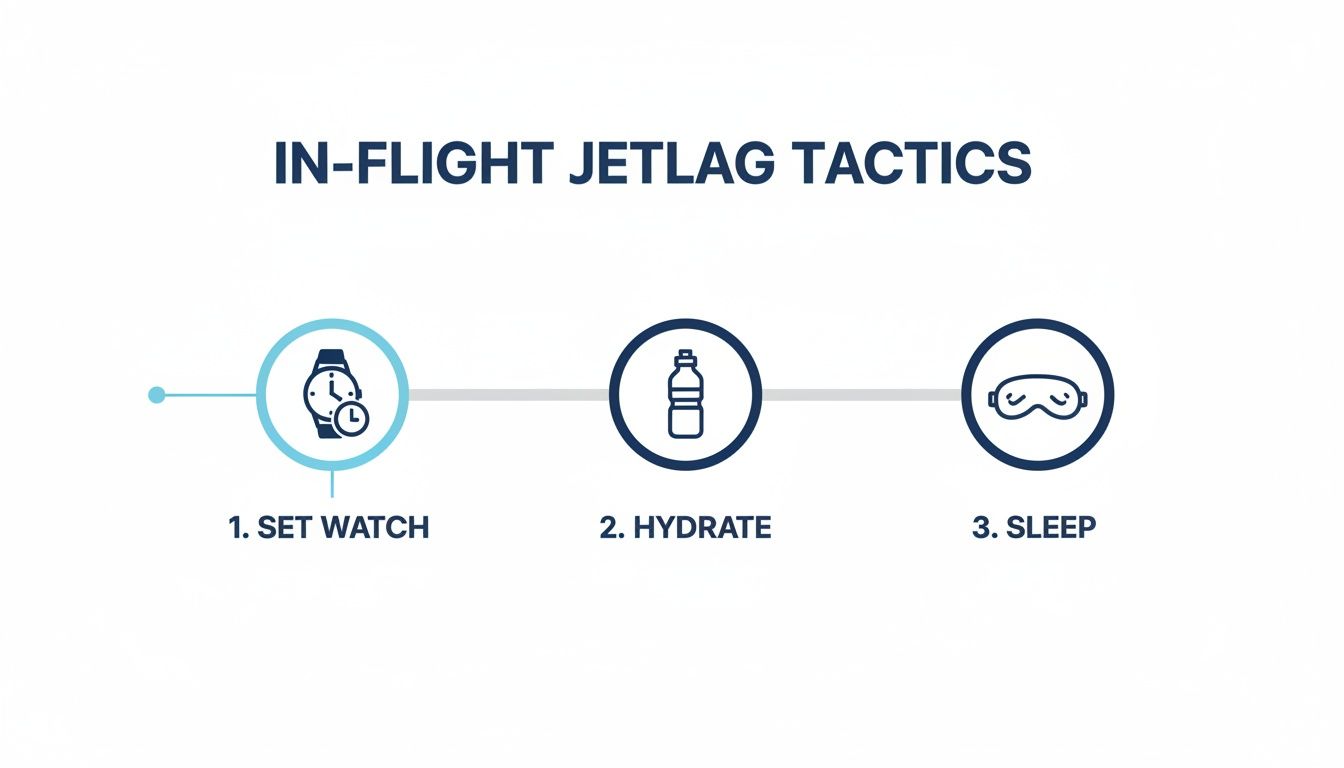
By setting your watch, staying hydrated, and sleeping on the plane as if you were already there, you've given yourself a massive head start. Now, it's time to bring it home.
Can you give me a sample arrival day plan?
Having a clear, time-blocked plan for your first day is the best defense against giving in to fatigue. This is especially true for shorter trips, where every hour counts. If you need more tips, check out our guide on how to plan a weekend getaway.
Your goal is to stay awake until at least 9 or 10 PM local time. Align your meals with local mealtimes—even if you're not hungry. Here is a sample schedule you can adapt for an eastward journey (like USA to Europe) with a morning arrival.
Sample First-Day Arrival Schedule (Eastward Travel)
| Time (Local) | Action | Why It Works |
|---|---|---|
| 8:00 AM | Arrival & Immigration. Clear customs, grab your bags. | The bright lights and activity of the airport help keep you alert. |
| 9:30 AM | Drop Bags & Get Outside. Check into your hotel, but don't linger. Immediately go for a 30-minute walk. | This exposes you to crucial morning sunlight, which tells your brain to suppress melatonin and start the day. |
| 11:00 AM | Light Activity & Coffee. Find a local cafe. Sit outside if possible. | A small dose of caffeine can help, but the main goal is continued light exposure and environmental immersion. |
| 1:00 PM | Lunch (Local Time). Eat a light, protein-focused meal. | Eating on the local schedule helps reset your body's internal digestive clock. Avoid heavy carbs that can make you sleepy. |
| 3:00 PM | Low-Key Sightseeing. Visit a park or an outdoor market. Keep moving. | Gentle physical activity boosts alertness and prevents you from crashing. This is often the hardest part of the day. |
| 5:00 PM | The 20-Min "Emergency" Nap. Only if absolutely necessary. Set two alarms. | If you can't push through, a very short nap can take the edge off without disrupting your nighttime sleep. |
| 7:00 PM | Light Dinner. Again, eat on the local schedule. Avoid alcohol. | Reinforces the new time zone's meal rhythm. Staying hydrated is key here. |
| 9:30 PM | Start Wind-Down Routine. Dim the lights in your room, read a book, and avoid screens. | This signals to your brain that sleep is approaching, allowing melatonin to rise naturally. |
| 10:00 PM | Lights Out. Aim for a full night of sleep. | You've successfully built up a full day's sleep pressure, making it much easier to fall asleep and stay asleep. |
This might feel tough, but forcing this immediate adaptation is the fastest path to feeling normal. Hiding in a dark hotel room only prolongs the misery. Stick to the plan, and you'll reclaim your trip.
The WanderAssist Reality Check
I'm going to tell you something most travel blogs won't: there's no magic pill that will instantly cure your jet lag. Honestly, the biggest tourist trap out there isn't a crowded landmark; it's the misguided belief that you can just "power through" exhaustion on your first day.
I've seen it a hundred times. A traveler lands in Paris and immediately rushes off to a four-hour tour of the Louvre. They end up miserable, irritable, and walking through the halls in a zombie-like haze, unable to appreciate a thing.
Price Warning: Don't Fall for the "Quick Fix"
Let's talk about the so-called "jet lag recovery" industry. You've seen the ads for trendy IV drips, special supplement blends, and fancy light therapy glasses. More often than not, these are just overpriced placebos preying on your desperation.
Your most powerful tools for beating jet lag are already at your disposal and they're completely free: sunlight, water, movement, and a bit of discipline. Save your money.
Instead of throwing cash at gimmicks, invest your energy in a solid plan. It's about managing expectations and being smart about how you schedule your arrival day. You have to prevent the burnout that comes from ignoring what your body is screaming at you. The WanderAssist 60-second planner can solve that decision fatigue by building a smart itinerary that eases you into the new time zone.
What are some common questions about jetlag?
You've got questions, I've got answers. Let's tackle the most common things people ask about getting over jet lag.
How long does it really take to recover?
The old rule of thumb is solid: plan for about one full day of recovery for every time zone you cross. But honestly, you can beat that timeline if you're disciplined from the moment you land.
Flying east, say from the US to Europe, is almost always tougher. Why? Because you're trying to force your body to go to bed hours before it thinks it should. The trick is to power through that first day, get as much bright sunlight as you can, and stick to the local schedule. Do that, and you can slash your recovery time.
Is melatonin actually a good idea?
Yes, but with a big caveat: you have to use it correctly. Most people take way too much. All you really need is a tiny dose, somewhere between 0.5mg and 3mg.
Think of melatonin less like a heavy-duty sleeping pill and more like a gentle nudge. It doesn't knock you out; it just sends a quiet signal to your brain that nighttime has arrived.
Take it about 30 minutes before your new local bedtime. Timing is everything—get it wrong, and you’ll just confuse your internal clock even more.
Can you be immune to jet lag?
Not really. No one is truly "immune," but some people handle it better than others. Those frequent flyers who seem to breeze through time zones? They aren't superhuman; they've just perfected their routines. A lot of it comes down to personal biology—your age, fitness level, and even your natural sleep-wake cycle. A significant time zone jump will mess with anyone's internal clock. The difference is simply having a good plan.
Planning a trip shouldn't feel like a science experiment. The WanderAssist 60-second planner builds realistic, time-blocked itineraries that account for travel fatigue, so you can enjoy your destination from day one. Get your smarter travel plan.