
The Real Deal on the Chicago to Las Vegas Drive

Planning the Chicago to Las Vegas drive? Get a realistic look at routes, timing, and costs. This no-nonsense guide helps you plan a trip without the burnout.
Let's cut to the chase. The drive from Chicago to Las Vegas isn't a weekend jaunt; it's a 1,750-mile haul. Doing it right means showing up in Vegas with enough energy to actually have fun, not feeling like you just finished an endurance race. A three-day schedule is the only sane way to tackle this.
What's This Drive Actually Like?
Forget what your GPS promises in a perfect, traffic-free world. Here’s the truth about what this trip looks like on the ground.
You're looking at a journey of roughly 1,750 miles. While mapping apps might quote a 25-hour drive time, that's just wheels turning. Factor in real-world delays—gas stops, grabbing food, stretching your legs, and the inevitable traffic around cities like Denver—and you’re realistically facing 27 to 29 hours behind the wheel.
Last time I made a cross-country trek like this, I realized the biggest win wasn't finding some quirky roadside attraction. It was pulling into my hotel with enough energy left to find a decent meal instead of collapsing on the bed.
Chicago to Las Vegas Drive: The Numbers
Here's a quick summary of what you're signing up for. This isn't inspiration; it's just the data.
| Metric | Realistic Estimate |
|---|---|
| Total Distance | Approximately 1,750 miles (2,816 km) |
| Realistic Drive Time | 27-29 hours (excluding overnight stops) |
| Minimum Trip Length | 3 days (strongly recommended for safety and sanity) |
| Estimated Fuel Cost | $350-$450 (for a standard car/SUV; prices vary) |
The key takeaway is that a three-day schedule is the only sane way to tackle this drive.
The biggest mistake people make is trying to cram this into two days. Trust me, that last leg becomes a miserable, caffeine-fueled endurance test. Spacing it out over three days transforms it from a grueling task into a manageable part of your vacation.
Should You Go North Through the Rockies or South on I-40?
The route you pick for your Chicago to Las Vegas drive is the single biggest decision you'll make. This isn't just about speed; it's a choice between two completely different road trip experiences. You're essentially choosing between the mountain drama of the northern route or the desert reliability of the southern one.
The Northern Route Through Denver
Most people default to this path. You’ll take I-80 across Iowa and Nebraska, then dip southwest on I-76 toward Denver. After that, it's I-70 through the Rockies before hitting I-15 in Utah for the final leg into Vegas.
When it comes to pure scenery, this route is the clear winner. The drive through Glenwood Canyon on I-70 in Colorado is genuinely impressive, with the highway carved into canyon walls just feet from the river. It’s a solid reward after the long, flat miles of the Great Plains.
But you have to respect the mountains. I learned this the hard way on a drive I thought was in a "safe" late May. A freak storm dumped a foot of snow on Vail Pass, instantly turning I-70 into a parking lot. It’s a serious reminder that mountain weather plays by its own rules. If you're driving this route anytime between October and late May, checking the mountain pass forecast isn't a suggestion—it's mandatory.
The Southern Route Through Albuquerque
Your other option is the southern route. This takes you down I-55 to St. Louis, then I-44 through Oklahoma before catching I-40 for the long haul west. This path roughly follows the spirit of old Route 66, and you’ll find plenty of kitschy diners and roadside attractions, especially around Tucumcari, New Mexico.
The biggest plus here is reliability. Barring a rare winter storm, this route is almost always clear. The terrain is flatter and the driving is, frankly, easier.
The downside? It can get incredibly monotonous. The long stretches across the Texas Panhandle and eastern New Mexico are vast—the kind of vastness that makes you wonder if you just missed the last gas station for 100 miles. Services can be surprisingly far apart, and the scenery doesn't offer much variety for hours at a time. It’s a workhorse route that gets the job done.
The WanderAssist Reality Check
To help you decide, let's put these two routes head-to-head. This isn't about which is "better," but which is right for your trip.
| Factor | Northern Route (via Denver) | Southern Route (via Albuquerque) |
|---|---|---|
| Scenery | Far superior, with the Rocky Mountains as the centerpiece. | Mostly flat plains and high desert. Can feel repetitive. |
| Weather Risk | High. Mountain passes can see snow and ice from October through late May. | Low. Generally milder and more predictable. |
| Road Conditions | Excellent interstate quality but prone to closures over high passes like Vail Pass (10,662 ft). | Good interstate quality. Less risk of weather-related closures. |
| Services | Plentiful through Nebraska/Denver, but can get sparse in western Colorado and Utah. | Services are clustered. Expect long gaps between towns in TX, NM, and AZ. |
| Worthwhile Stops | Denver, Colorado mountain towns (e.g., Glenwood Springs). | Oklahoma City, Albuquerque's Old Town, Route 66 spots. |
| Price Warning | Fuel prices in remote mountain and desert towns can be significantly higher than in urban areas. Don't wait until your tank is empty to fill up. |
Here’s my take: if you're traveling from June to September, the northern route is the clear winner for an engaging drive. But if you’re traveling in the shoulder seasons—or you absolutely cannot afford a weather delay—the southern route is the safer, more predictable bet. That decision fatigue is a real problem, and it's what the WanderAssist 60-second planner is designed to solve.
The final stretch of the northern route also puts you tantalizingly close to some major national parks. While a full detour to Zion might be too much for this trip, if you build in an extra day, our guide on the drive from Las Vegas to Bryce Canyon can give you a ready-made plan.
Is there a 3-Day Itinerary That Won't Cause Burnout?
Yes, but you have to be disciplined. Trying to drive from Chicago to Las Vegas in just two days is a classic rookie mistake. The only sensible way to tackle this is to spread it out over three days. This plan is a straightforward, no-nonsense strategy designed to get you there safely and with your sanity intact. We'll anchor each night's stay in a city with plenty of reliable, affordable lodging.
Here’s a head-to-head look at how the Northern and Southern routes break down.
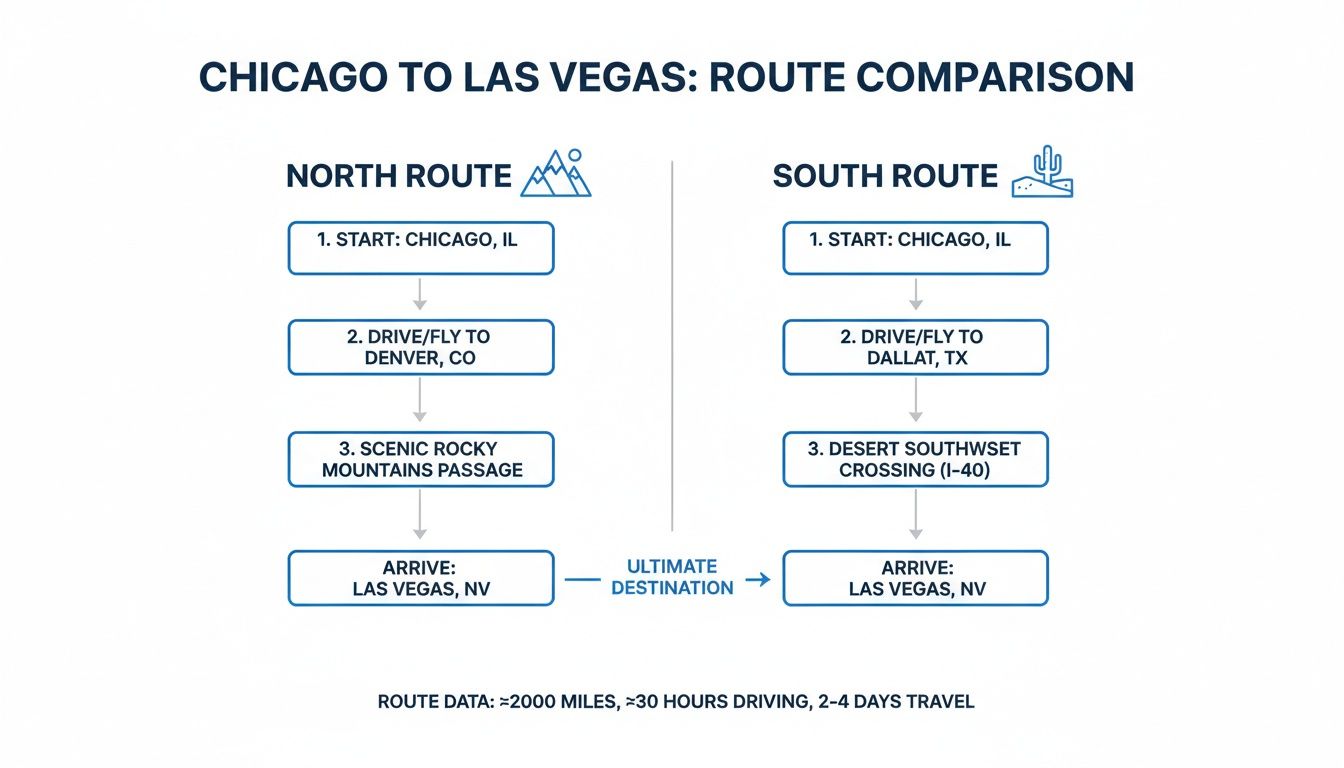
This visual gets right to the point. You're choosing between the mountain scenery of the Northern Route and the more predictable desert drive of the Southern Route. That choice sets the tone for your entire trip.
Day 1: Chicago to Lincoln, Nebraska (Northern Route Anchor)
Your first day is all about putting miles behind you. You’re trading the dense traffic of Chicago for the wide-open spaces of Illinois and Iowa.
- Total Distance: Around 500 miles
- Drive Time: 7.5 - 8 hours (not counting major stops)
- The Route: I-88 W to I-80 W
The goal is to cross the Mississippi and get deep into Nebraska. Lincoln is the perfect spot to stop. It's big enough to offer a wide selection of decent, affordable hotels right off I-80, so you won't waste time navigating a complex city.
I once made the mistake of pushing past Lincoln, thinking I'd get a jump on Day 2. It was a bad idea. I ended up exhausted in some tiny town with a single, overpriced motel. Just stick to Lincoln; it's the smart, low-stress move.
Day 2: Lincoln to Grand Junction, Colorado (Neighborhood Anchor)
Today is where the drive completely transforms. You'll wake up on the plains and end your day on the edge of the desert, with the Rocky Mountains dominating your view for hours.
- Total Distance: Roughly 540 miles
- Drive Time: 8 - 8.5 hours (without major stops)
- The Route: I-80 W to I-76 W to I-70 W
The stretch of I-70 through Glenwood Canyon is impressive. Your target for the night is Grand Junction, Colorado. It sits on the western slope of the Rockies, which means you’ve already tackled the toughest mountain passes. Stopping here sets you up for an easier, mostly downhill desert drive on your final day.
Day 3: Grand Junction to Las Vegas, Nevada (Final Leg)
The final push. Today is all about the stark landscapes of eastern Utah and southern Nevada. You’ll leave the greens of the mountains behind for red rocks and vast horizons.
- Total Distance: About 460 miles
- Drive Time: 7 hours (without major stops)
- The Route: I-70 W to I-15 S
This leg of the journey can feel incredibly long. The Virgin River Gorge in Arizona, just before you cross into Nevada, offers one last scenic punch. After that, it’s a straight shot into the Las Vegas valley.
Timing Tip: The final approach into Vegas on I-15 is notorious for traffic, especially on a Friday or Saturday. Leaving Grand Junction early in the morning helps, but you can still hit a wall of cars starting from Mesquite. If you can, plan this last leg for a weekday. You can see the hard data for yourself on Rome2Rio.
Having this three-day framework is a great start, but turning it into a real schedule is what makes it work. If you’re ready to flesh this out, check out our guide on how to create a travel itinerary that actually works. Or, you can just let the WanderAssist 60-second planner do the heavy lifting.
How Much Will This Drive Actually Cost?
<iframe width="100%" style="aspect-ratio: 16 / 9;" src="https://www.youtube.com/embed/Z6_qoK3M7S4" frameborder="0" allow="autoplay; encrypted-media" allowfullscreen></iframe>Let's get down to the numbers. A road trip budget is about more than just gas. You need a clear picture of fuel, lodging, and food for at least two nights on the road.
Is Driving Actually Cheaper Than Flying?
For two or more people, driving is almost always the smarter financial move. Once you add up round-trip airfare, checked bag fees, and the cost of a rental car in Vegas, the expenses skyrocket. A solo traveler might break even with a cheap flight deal, but that's about it.
Here’s a realistic cost breakdown for a three-day, one-way journey.
- Fuel: This is your biggest variable. Driving a standard car that gets around 25 MPG, expect to spend $250-$300 one way. For an SUV or truck, that figure jumps to $350-$450.
- Lodging: Two nights in decent, reliable roadside hotels in towns like Lincoln or Grand Junction will run about $125-$175 per night. Total accommodation cost: $250-$350.
- Food & Drinks: Budgeting $60-$80 per person, per day allows for a mix of quick bites and a couple of sit-down meals. For a solo driver, that's $180-$240 for the whole drive.
A solo traveler should plan for a total cost of around $680-$890. For a pair, that number is closer to $900-$1,200. You can find more analysis in these insights on road trip costs.
The last time I made this drive, my savings on airfare covered my entire food and entertainment budget for four days in the city. That's a trade-off I’ll take every time.
What Are The Real Dangers on a Chicago to Las Vegas Drive?
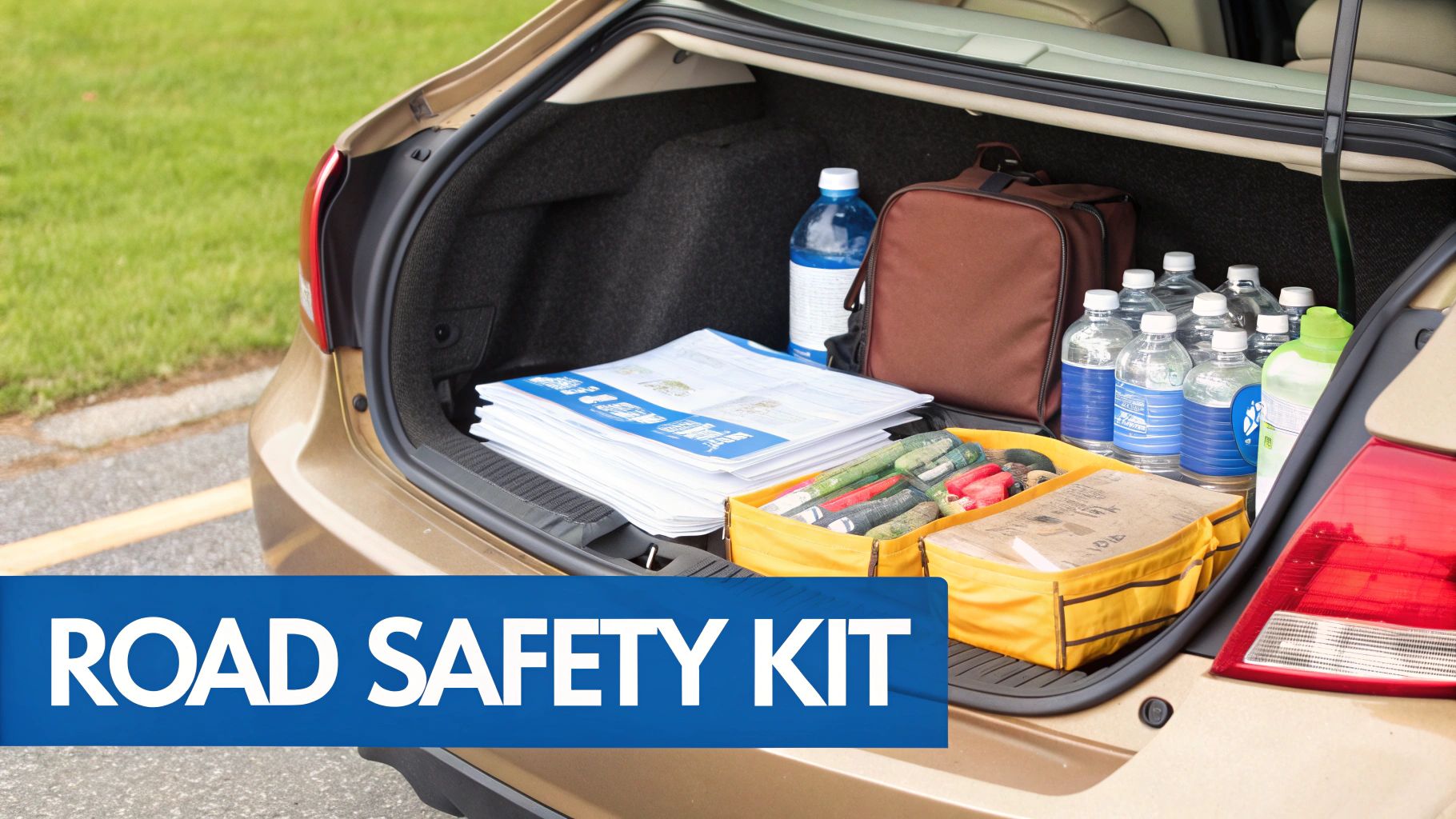
This isn't just about packing a suitcase. Those long, empty stretches of highway demand some real preparation. Before you leave Chicago, get your car's oil, tire pressure (including the spare!), and wiper fluid checked.
Your Roadside Emergency Kit
At a bare minimum, you should have these in your trunk:
- A good first-aid kit: One with antiseptic wipes, gauze, and medical tape.
- Jumper cables: A dead battery is a five-minute fix with these, and a trip-ending disaster without them.
- Portable tire inflator: Plugs into your car's 12V outlet. It's the difference between limping to the next town and waiting hours for a tow truck.
- Emergency water and food: Keep at least a gallon of water and some high-energy snacks in the car.
The WanderAssist Reality Check: No Signal & Highway Hypnosis
For huge portions of this drive, your phone will be a useless brick. On my last drive through rural Utah, I had zero service for almost two hours straight. If I'd gotten a flat tire then, I would have been completely on my own.
This is why downloading offline maps for your entire route is not a friendly suggestion—it’s mandatory. You cannot count on having a data connection when you need to find the next gas station.
The other real danger is highway hypnosis. The long, straight, monotonous roads through Nebraska can lull you into a daze where your eyes are open but your brain has checked out. The best way to fight it is to stay engaged. Switch from music to a podcast. Stop every 90-120 minutes, even if it’s just for five minutes to stretch. It might feel like a delay, but it's a critical safety break.
For more packing ideas, our complete list for packing for a trip goes into more detail.
Your Road Trip Questions, Answered
Here are some quick, no-fluff answers to the questions I get asked most about this drive.
When’s The Best Time of Year To Make This Drive?
Aim for late spring (May to early June) or early fall (September to October). You dodge the brutal summer desert heat and, more importantly, sidestep the risk of a snowstorm shutting down the mountain passes in Colorado. Trying this in winter on the northern route is a roll of the dice against blizzards and road closures.
How Do I Find Good Food That Isn't a Burger Chain?
It takes a little planning. The trick is to look beyond the interstate exits and explore the mid-sized towns you'll be driving through.
- Neighborhood Anchor: Lincoln, NE: The Haymarket District has a bunch of local restaurants and breweries.
- Neighborhood Anchor: Grand Junction, CO: Pull off the highway and head to Main Street. You'll find independent cafes that feel like a real escape from the road.
- Your map app is your best friend: Before you get hungry, pull over, zoom in on the next town on your route, and search for "diner" or "cafe." It almost always turns up something better than the highway signs are advertising.
Is The Chicago To Las Vegas Drive Safe To Do Solo?
Absolutely, as long as you take standard precautions. The biggest risks for a solo driver aren't other people—it’s exhaustion and car trouble. Don't try to be a hero and do it in two days. Stick to a three-day plan, make sure someone has your itinerary, and adopt this rule: once you're west of Denver, never let your gas tank fall below half.
Juggling all these little details—routes, stops, drive times, hotels—can turn an exciting trip into a logistical headache.
Instead of getting lost in a dozen browser tabs, let WanderAssist handle it. We can build your entire day-by-day Chicago to Vegas itinerary, optimized for realistic driving times and smart stops, in less than a minute. It’s designed to prevent burnout so you can actually enjoy the journey.
Get your custom, ready-to-go plan right now at https://wanderassist.com.