
Your Anti-Tourist List for Packing for a Trip: 10 Essentials for 2026
Discover the list for packing for trip that keeps you light, organized, and fatigue-free with 10 essentials.
Forget bloated packing lists designed to sell you junk. A heavy bag chains you to your hotel and turns a simple walk into a chore. This is your essential, anti-tourist list for packing for a trip, built to keep you light, mobile, and ready to experience a city on your terms, not burdened by your luggage.
Last time I was in Rome, I watched a couple dragging two massive suitcases over cobblestones just to get to a cafe. That’s the kind of travel fatigue this guide prevents. We’re skipping the “just in case” items and focusing on versatile gear that lets you explore all day. This isn't just a list; it's a system to reclaim your energy and focus on the experience.
Is a Lightweight Day Backpack Really Necessary?
Yes. Forget the bulky hiking pack; your daily carry should be discreet and comfortable. A lightweight day backpack is the single most important piece of gear for executing a packed itinerary without burning out. It's about mobility and blending in, which is a core part of any good list for packing for a trip.
Why It’s Key for Urban Itineraries
A proper daypack (under 1.5 lbs) is your mobile base camp. It lets you carry essentials for a full 8-10 hour day, moving between neighborhoods without returning to your hotel. The right pack avoids the "I'm a tourist" signal that a massive bag sends, which often makes you a target. Last time I was navigating the tight alleys of Lisbon, I realized my small, neutral-colored pack let me slip into local cafes without a second glance.
How to Use It Effectively
When selecting a daypack, prioritize function. Look for these specific features:
- Weight Distribution: Pack heavier items like a water bottle closest to your spine. It makes a huge difference in comfort by the end of the day.
- Strategic Organization: Use small packing cubes inside the backpack for electronics, snacks, and first-aid. This stops you from dumping everything out on a busy street corner to find your charger.
- Discreet Design: Choose neutral, dark colors like black, navy, or gray. A reversible option that can switch between two subtle shades is even better.
- Adjustability: Ensure the shoulder straps are well-padded and easily adjustable. A poorly fitting pack will cause fatigue.
Do I Really Need a Portable Charger and Adapter?
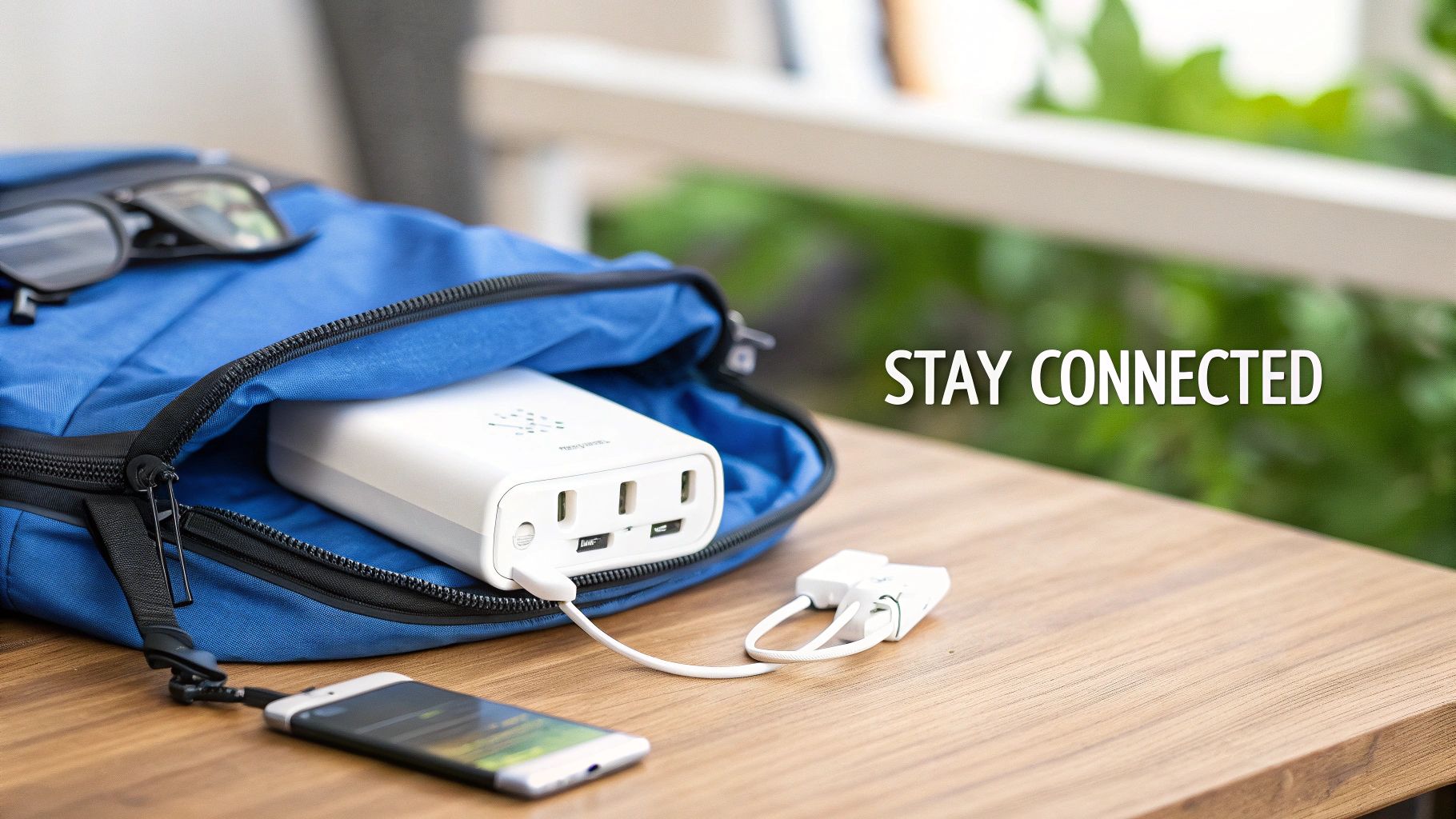
Absolutely. In 2026, a dead phone isn't an inconvenience; it's a critical failure that can derail your entire day. A high-capacity portable charger and a universal adapter are your technological lifeline. These items are non-negotiable on a modern list for packing for a trip.
Why They’re Essential for Itineraries
Your smartphone is your map, planner, and emergency contact. A powerful portable battery (20,000mAh+) gives you the security to use these tools without rationing power. I learned this the hard way in a Kyoto hotel when I realized my US plug was useless, forcing a late-night scramble to find an overpriced, single-country adapter.
How to Choose and Use Them
Don't just grab the cheapest tech accessories; invest in reliability. Look for these features:
- High Capacity & Fast Charging: Select a power bank with at least 20,000mAh. Ensure it supports fast charging (like USB-C PD) to quickly top up your devices during a short cafe break.
- Multi-Port Functionality: A good universal adapter should have multiple USB ports in addition to the main AC outlet. This lets you charge everything from a single wall socket.
- Voltage Compatibility: Before you leave, check your destination’s voltage (e.g., 110V in the US vs. 220-240V in Europe/Asia) and ensure your adapter and devices are compatible.
- Organized Storage: Keep your charger, adapter, and cables in a small, dedicated tech pouch. This prevents a tangled mess at the bottom of your bag.
What Are the Best Shoes for a Walking-Heavy Trip?
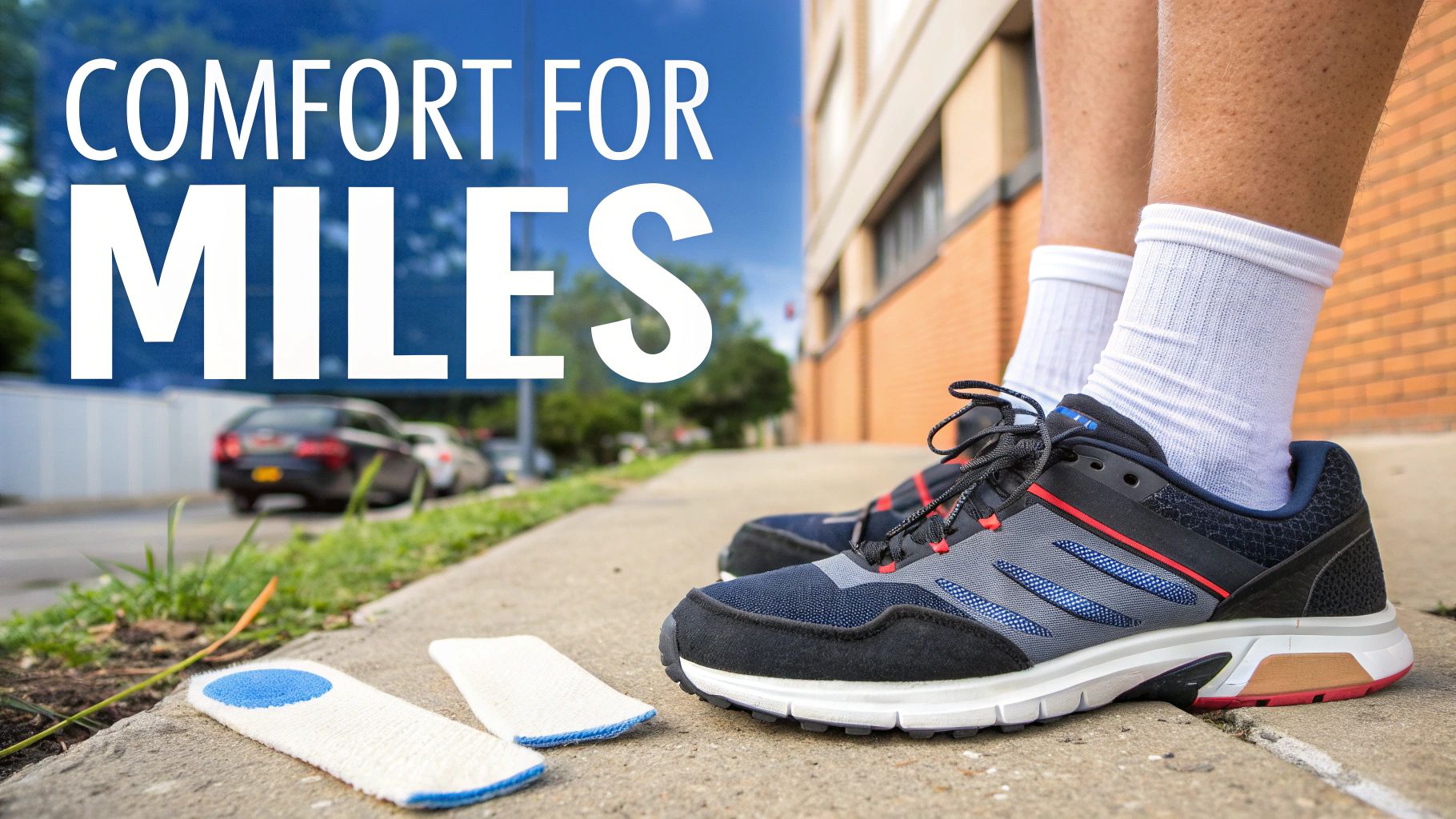
The most ambitious itinerary is worthless if you can’t walk more than a mile without pain. Properly fitted, broken-in walking shoes are the foundation of any successful urban exploration. This isn't just a comfort item; it's a critical tool on any list for packing for a trip.
Why They’re Critical for Urban Exploration
An average day of city exploration can easily cover 8-12 km. Without the right footwear, this quickly becomes an ordeal. I once made the mistake of wearing brand-new boots in Paris and spent half my trip searching for pharmacies instead of cafes. Your shoes directly impact your endurance.
How to Prepare Your Feet
Choosing the right shoe is only half the battle; how you prepare is what matters.
- Pre-Trip Break-In: Never wear new shoes on a trip. Break them in for at least two weeks with progressively longer walks. This reveals potential hotspots before they become trip-ruining blisters.
- Sock Strategy: The right socks are just as important as the shoes. Pack moisture-wicking merino wool or synthetic socks. Avoid cotton at all costs.
- Blister Prevention Kit: Be proactive. Pack a small kit with moleskin and blister patches. Applying moleskin to a sensitive area before a blister forms is the key.
- Orthotic Support: If you use orthotic inserts, bring them. Travel is not the time to test your feet without their usual support. You can explore how to integrate rest periods for your feet when you create a pace-optimized travel itinerary.
Why Pack a Rain Jacket if the Forecast is Clear?
Because forecasts are often wrong. Don't let an unexpected downpour derail your day. A lightweight, packable rain jacket is your insurance policy against volatile weather and a non-negotiable on your list for packing for a trip. It means you don't have to duck into an overpriced cafe or buy a flimsy, disposable poncho.
Why It’s Key for Any Itinerary
A good packable rain jacket frees you from the tyranny of the forecast. On a recent trip to Paris, a sudden May shower cleared the crowds from the Tuileries Garden. Because I had my jacket, I got to enjoy a normally packed space in near solitude. This simple item prevents the weather from dictating your movements.
How to Choose and Use It
Functionality and packability are the goals. Look for these features:
- Quick Deployment: Store the jacket in an easily accessible outer pocket of your daypack. You should be able to put it on in under a minute.
- Neutral Design: Choose a jacket in a subtle color like gray, black, or navy. This helps you blend in.
- Smart Layering: For temperature control, wear a lightweight long-sleeve shirt underneath. A rain jacket can trap heat, and this base layer helps manage comfort.
- Pre-Trip Check: Always test the jacket's waterproofing before you leave. A quick run under the shower can reveal any failing seams.
- Moisture Prevention: Pack it in its own small, waterproof stuff sack inside your backpack to contain any dampness after use.
How Can I Pack Toiletries Without Overpacking?
Master the art of travel-sized toiletries. It’s a non-negotiable skill for any efficient traveler, preventing security delays and saving precious luggage space. This is a fundamental part of any smart list for packing for trip.
Why It's Essential for a Smooth Trip
A well-organized, TSA-compliant toiletry bag is your ticket to a smooth start. Last time I flew through Heathrow, having my clear bag ready with 100ml containers meant I was through security in minutes while others were frantically repacking. For medications, having them properly organized in original containers isn't just about convenience; it’s about avoiding serious issues with customs officials.
How to Downsize Effectively
Strategically downsizing your liquids and pills is an easy win. Focus on these actions:
- TSA Compliance: All liquids must be in containers of 100ml (3.4 ounces) or less, placed inside a single, clear, quart-sized zip-top bag. This is non-negotiable for carry-on.
- Solid Alternatives: Switch to solid toiletries. Shampoo bars, solid conditioner, and bar soap are fantastic space-savers and eliminate the risk of spills.
- Medication Management: Keep all prescription medications in their original, labeled containers. Carry a digital or paper copy of your prescription, especially for controlled substances.
- Pre-Trip Preparation: Don't wait until the night before to source your travel-sized items. Purchase or decant them a week in advance.
Are Physical Maps Still Relevant in 2026?
Yes, as a backup. Relying solely on your phone for navigation is a rookie mistake. A dead battery, a lost signal, or exorbitant data roaming charges can instantly derail an itinerary. A hybrid approach—physical maps plus a pre-configured offline navigation setup—is the professional traveler’s insurance policy and a critical part of any smart list for packing for a trip.
Why You Need a Backup System
This dual-navigation system ensures you remain self-sufficient. A laminated city map lets you see the bigger picture of a neighborhood, something a small phone screen struggles to convey. On my last trip to Florence, my phone died unexpectedly, but having the hotel’s free map with my key destinations circled meant I could navigate back through the winding medieval streets without a moment of panic.
How to Set Up Your Navigation
Prepare your navigation tools before you leave. It takes just a few minutes.
- Offline App Setup: Before your trip, while you have strong Wi-Fi, open an app like Google Maps. Search for your destination city and use the "Download offline map" feature for the entire area.
- Physical Map Annotation: Get a paper map from your hotel. Use a pen to circle your hotel and key landmarks. This helps you build a mental model of the city’s layout.
- Create a Digital Backup: Take a clear photo of your annotated paper map with your phone. If the physical map gets lost, you still have a visual reference.
- Learn Key Intersections: Use both maps to identify major streets. Knowing your hotel is two blocks north of a major avenue is more useful than blindly following a blue dot.
Should I Really Bother Packing a Water Bottle?
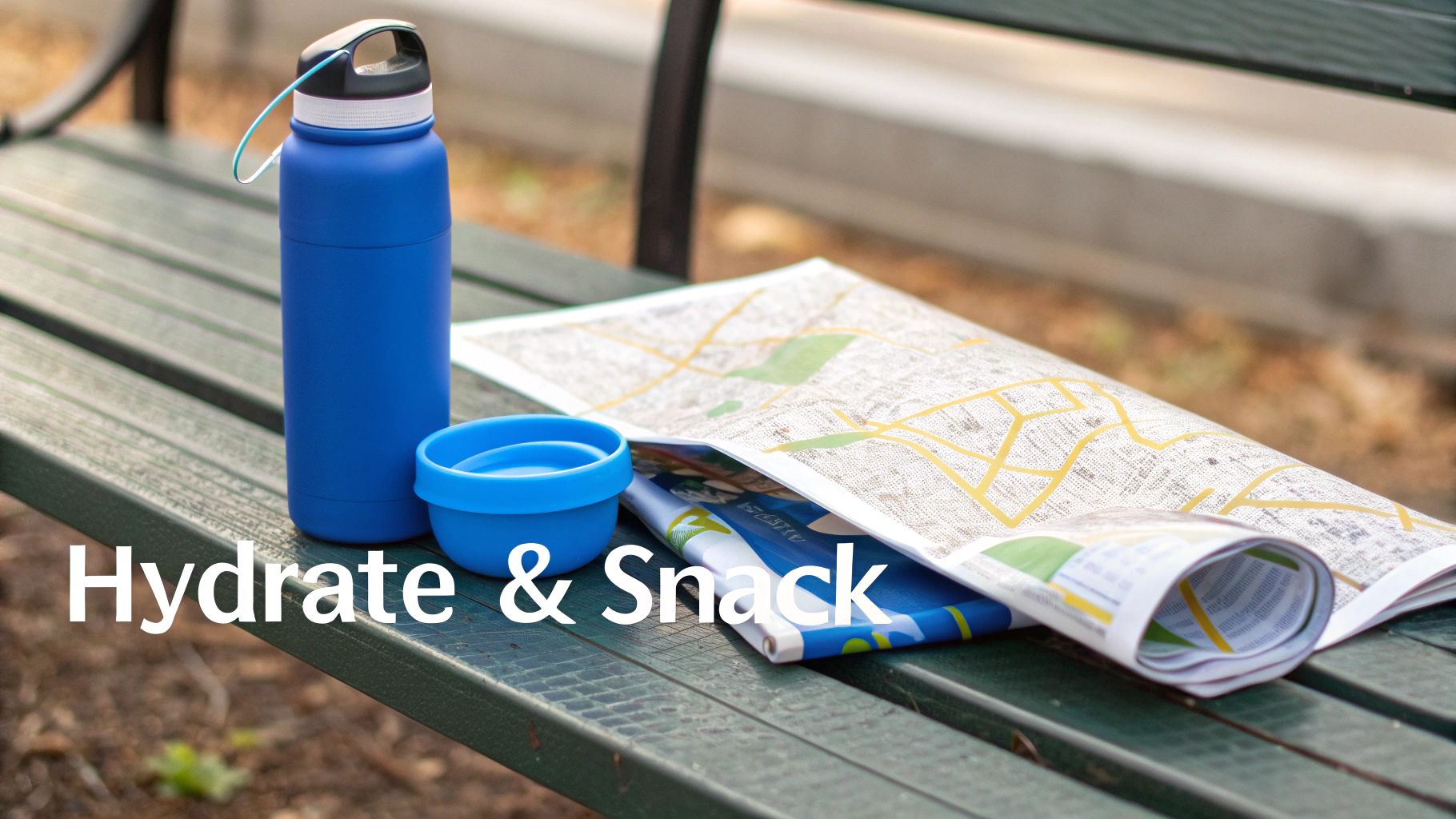
Yes. Relying on expensive cafes for water and snacks drains your budget and your energy. A lightweight, refillable water bottle and a collapsible snack container are non-negotiable. Staying hydrated and fueled is fundamental to executing a packed itinerary, making these a crucial part of any smart list for packing for trip.
Why It’s Key for Full-Day Itineraries
Constant walking dehydrates you faster than you think. Having your own water supply saves you from paying €3 for a tiny bottle at a tourist kiosk. A personal snack stash prevents "hanger" from derailing your afternoon. I once navigated a full day in Florence entirely powered by a Nalgene and a container of almonds, saving me at least €15 and an hour of wasted time.
How to Implement This Strategy
The goal is a self-sufficient system for on-the-go sustenance.
- Plan Your Refills: Fill your bottle at your accommodation each morning. Use apps like Find A Fountain to locate public water sources.
- Smart Snacking: Pack your container with high-energy foods like nuts or dried fruit. These provide sustained energy, unlike sugary snacks that lead to a crash.
- Calculate Your Needs: A good rule of thumb is to drink about 250ml of water for every hour of walking. Adjust up for hotter climates.
- Double-Duty Use: On my last trip, I froze a half-full bottle overnight. It acted as a mini ice pack for my bag and provided ice-cold water by midday as it melted.
Isn't One Charging Cable Enough?
No. A dead phone is the fastest way to derail a day of exploration. Multiple backup charging cables are non-negotiable insurance against this modern travel disaster. This simple tech combo is an indispensable part of any smart list for packing for a trip.
Why Redundancy is Essential
Your phone is your command center. Having redundant charging cables (one in your daypack, one in your main luggage) means a frayed or lost cable never becomes a trip-ending emergency. Last time I was navigating the metro in Tokyo, my primary cable failed. Having a backup in my bag meant I could recharge on the go and didn't miss my connection. A universal phone mount also enables hands-free GPS navigation, letting you glance at your route without constantly holding your device, which drains the battery.
How to Prepare Your Tech Gear
Securing your digital lifeline requires a bit of forethought.
- Mount for Quick Deployment: Use a compact mount to quickly set it up on a cafe table to review your next move without holding your phone.
- Cable Redundancy: The "two is one, one is none" rule applies here. Keep one high-quality, braided cable in your daypack and a spare in your main suitcase.
- Smart Cable Choice: Opt for cables that are at least 6 feet long. This gives you the flexibility to charge from awkwardly placed outlets.
- Discreet Usage: When using a mount in public, be mindful. The goal is to blend in, not advertise an expensive device.
Why Pack Sunscreen If I'm Just in a City?
Because failing to pack basic sun protection is a rookie mistake. A bad sunburn isn't just uncomfortable; it can lead to fatigue and force you to spend a precious vacation day recovering indoors. Treating these items as non-negotiable "daycare essentials" is a strategy for endurance and enjoyment.
Why It’s Essential for Urban Itineraries
Proper sun protection is your defense against cumulative exposure. Moving between sunny plazas, open-air markets, and long queues leaves you vulnerable, even on overcast days. Last spring in Seville, I watched dozens of tourists turn lobster-red by 3 PM, while my packable hat and travel-sized sunscreen let me enjoy the city's parks well into the late afternoon.
How to Use Sun Protection Strategically
Making sun protection an effortless habit is key.
- Systematic Application: Apply a broad-spectrum sunscreen (SPF 30+) at least 15 minutes before you leave your hotel. Set a recurring alarm on your phone to reapply every 2-3 hours.
- Leak-Proof Storage: Always pack sunscreen inside a small, sealed waterproof bag. A leak inside your daypack can ruin electronics.
- Targeted Coverage: Use a hat during peak sun hours (10 am to 4 pm). Remember to apply sunscreen to often-missed spots like your ears and the back of your neck.
- Subtle Style: Choose sunglasses and hats that blend with your outfits to avoid the conspicuous "tourist" uniform.
Is Travel Insurance Documentation Really a "Packing" Item?
Yes. This isn’t glamorous, but it’s the one that can save a trip from total disaster. Comprehensive travel insurance and well-organized emergency documents are your non-negotiable safety net. It's a critical, often-overlooked component of a smart list for packing for a trip.
Why It's Non-Negotiable
Things go wrong. A missed flight, a sudden illness, or a lost passport can derail everything. Having your insurance policy and emergency contacts organized means you can handle a crisis with calm efficiency. Last time I was in Bangkok, my travel partner got food poisoning. Having the insurance policy number on a card in my wallet meant we could call the 24/7 assistance line and get directed to a reputable clinic immediately, without worrying about the cost.
How to Organize Your Documents
Preparing this documentation is about creating redundant, accessible systems.
- Digital Redundancy: Store digital copies of your passport, visa, and insurance policy in two separate cloud services (like Google Drive and Dropbox). Also, create a "Travel Docs" folder on your phone with photos of everything for offline access.
- Physical Backup: Print one physical copy of these critical documents. Keep them in your main luggage, separate from the originals.
- Immediate Access: Save your insurance provider’s 24/7 emergency hotline and your policy number as a contact in your phone. Put this info on a small card in your wallet.
- Stay Registered: Before you leave, register your trip with your country's embassy or consulate service (like the U.S. Smart Traveler Enrollment Program). This helps them locate you in an emergency. Preparing for these contingencies is a key aspect of effective trip planning, much like what’s covered in our guides to business travel planning.
The WanderAssist Reality Check
Price Warning: The "travel-sized" section at your local pharmacy is a tourist trap. Those tiny bottles of brand-name products are marked up by 200-300%. Don't pay $4 for 50ml of sunscreen you can get for $10 in a 250ml bottle. Buy a set of reusable, leak-proof silicone travel bottles for $15 and decant your own products from full-sized containers. You'll save money and reduce plastic waste.
10-Item Travel Packing Comparison
| Item | Implementation Complexity 🔄 | Resource Requirements ⚡ | Expected Outcomes 📊 ⭐ | Ideal Use Cases 💡 | Key Advantages ⭐ |
|---|---|---|---|---|---|
| Lightweight Day Backpack | Low 🔄 — buy/pack, minimal setup | Moderate ⚡ — $80–150+, 15–20L, <1.5 lbs | High 📊 — improved mobility, less fatigue, discreet appearance | Full-day urban itineraries, neighborhood linger zones | Hands-free exploration; reversible style; ergonomic comfort |
| Portable Phone Charger & Universal Adapter | Low 🔄 — plug-and-go maintenance | Moderate ⚡ — 20k–30k mAh, ~400g, $40–100+ | Very high 📊⭐ — continuous connectivity, reliable navigation | All-day use, multi-device charging, international trips | Extended battery life; multi-port charging; global plug coverage |
| Comfortable Walking Shoes | Medium 🔄 — sizing and break-in required | High ⚡ — $100–250+, time to break in, possible orthotics | Very high 📊⭐ — prevents foot pain, enables long-distance walking | 8–12 km walking days, linger zones, mixed urban surfaces | Superior cushioning/arch support; blister prevention; durability |
| Lightweight, Packable Rain Jacket | Low 🔄 — simple packing and deployment | Moderate ⚡ — $80–200+, 200–400g packdown | High 📊 — protects itinerary continuity during bad weather | Unpredictable climates, multi-day urban exploration | Waterproof protection; highly packable; layering versatility |
| Compact Toiletries & Medications | Low 🔄 — organize into TSA-compliant bag | Low ⚡ — small cost, may need mid-trip refills | Moderate 📊 — faster security, lighter carry-on, hygiene maintained | Short trips, carry-on-only travel, airport security | TSA compliance; reduced weight; streamlined security checks |
| Physical Maps & Offline Navigation Setup | Medium 🔄 — download maps + mark paper maps | Low ⚡ — prep time, minor cost for prints/laminate | High 📊⭐ — reliable navigation offline, reduced dead-phone anxiety | Areas with poor connectivity, battery-conservation, cultural immersion | Offline redundancy; improves orientation; low-tech backup |
| Reusable Water Bottle & Snack Container | Low 🔄 — fill and pack daily | Low ⚡ — $30–60+, weight when full (up to 750ml) | High 📊 — sustained hydration/energy, cost and waste savings | Long walking days, picnics, avoiding frequent café stops | Hydration; cost savings; waste reduction; compact storage |
| Backup Charging Cables (2–3) | Low–Medium 🔄 — simple redundancy check | Low–Moderate ⚡ — multiple cables cost/weight | Moderate–High 📊 — mitigates cable failure, ensures charging | Frequent navigation transitions, long outings away from lodging | Charging redundancy; peace of mind; flexibility |
| Sun Protection Essentials | Low 🔄 — routine application and storage | Low ⚡ — $20–40+, small weight (<300g) | High 📊⭐ — prevents sunburn/heat issues, improves comfort | Sunny climates, outdoor linger zones, long exposures | Sun protection; reduces heat-related interruptions; low weight |
| Travel Insurance & Emergency Docs | Medium 🔄 — purchase, read policy, organize copies | Moderate ⚡ — $50–300+ premium, time to prepare docs | Very high 📊⭐ — financial and logistical protection in emergencies | International travel, long trips, higher-risk activities | Financial coverage; 24/7 support; digital + physical redundancy |
Your Final Check Before You Zip Your Bag
Before you zip that bag shut, this is your final check-in. The goal isn't preparing for every hypothetical disaster; it’s handling common challenges with minimal friction. Your list for packing for a trip is a tool for freedom, not a burden. Last time I was in Tokyo, my phone died right before I needed to show my digital train pass. Because I had that small portable charger, it was a minor two-minute inconvenience, not a trip-derailing crisis. That’s the difference between a smart packer and an over-packer.
Key Takeaways Distilled
If you forget everything else, remember these principles:
-
Prioritize Mobility Over "Just in Case": The heaviest thing you can carry is the weight of items you don't use. Every "just in case" sweater anchors you to your hotel. The best moments happen when you're light enough to say "yes."
-
Versatility is the Ultimate Hack: A reversible jacket is two jackets. A neutral pair of pants works for a casual cafe and a nicer dinner. Choosing items that serve multiple purposes multiplies your wardrobe without multiplying your weight.
-
Self-Sufficiency Creates Calm: Having a first-aid kit, a power bank, and offline maps means you've eliminated common travel stress. Instead of panicking, you solve the problem in seconds and get back to enjoying your day.
Actionable Next Steps
Before you close that suitcase, perform this final audit.
- The "Double-Up" Purge: Look at every single item. Can another item you've already packed do its job? Be ruthless.
- The "Wear-Out" Test: Are you wearing your bulkiest shoes and your heaviest jacket on the plane? This is the easiest way to free up space.
- The Digital Pre-Load: Is your phone ready? Have you downloaded offline maps, airline apps, and tickets?
Mastering your packing list is about buying back your time and energy. You're not just packing a bag; you're designing a smooth, adaptable experience. Now, zip it up and go.
Feeling the decision fatigue of planning the rest of your trip? The same smart, reality-first approach from this packing guide is the engine behind WanderAssist. Our 60-second planner creates pace-optimized, neighborhood-anchored itineraries that prevent burnout. Get your personalized travel plan at WanderAssist.