
Vegas to Flagstaff: A No-Nonsense Road Trip Guide
Planning the drive from Vegas to Flagstaff? Get the honest route options, essential stops, and timing tips to avoid crowds and actually enjoy the journey.
Let's get this straight: the drive from Las Vegas to Flagstaff is about 4.5 hours if you just floor it. But rushing this trip is a rookie mistake. The smart play is to take US-93 to I-40 E, make one strategic stop at the Hoover Dam, and get there before the tour buses descend. To beat the Vegas morning exodus and the worst of the Arizona sun, you need to be on the road by 7 AM, no excuses.
Is the drive from Vegas to Flagstaff worth it?
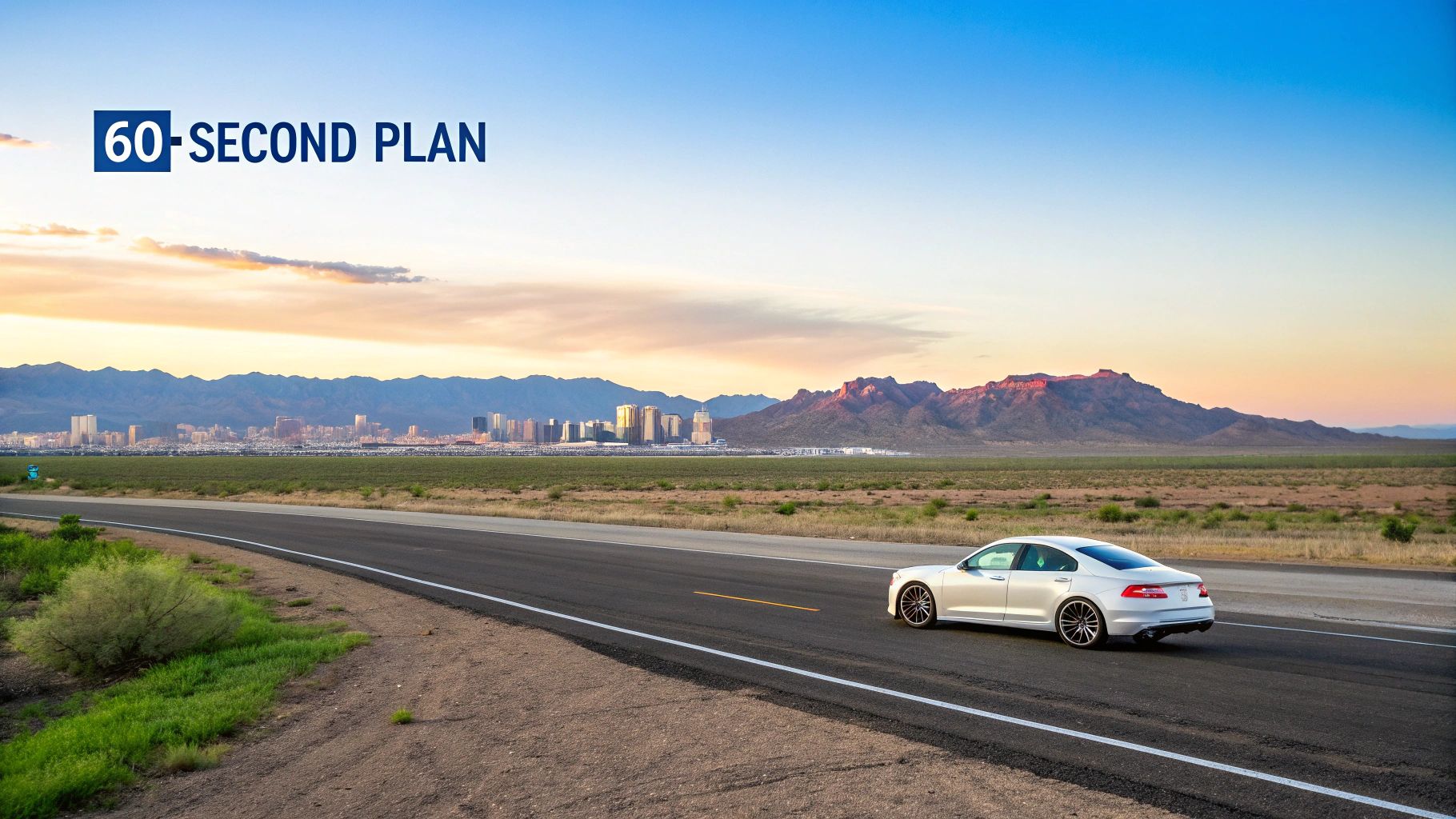
This isn't just a monotonous desert slog; it’s a classic American road trip. This 252-mile journey has become a go-to escape route for people looking for a change of pace.
With Las Vegas seeing an average of 114,182 visitors arriving every single day, it's no surprise people are looking for a break from the Strip. Flagstaff, with its cool mountain air and gateway-to-the-Grand-Canyon status, is a solid destination. You can dig into the full tourism trends on Roadgenius.com.
Let's cut the fluff. This guide gives you a real, practical plan for the drive. We'll cover everything you actually need to know.
Vegas to Flagstaff Drive: The 60-Second Answer
Here’s a quick rundown of what to expect on your trip. Think of this as your cheat sheet for the road.
| Metric | Details |
|---|---|
| Total Distance | Approximately 252 miles (406 km) |
| Drive Time | 4 to 4.5 hours (without any stops) |
| Main Route | US-93 South to I-40 East |
| Timing Tip | Leave by 7 AM to avoid Vegas traffic & desert heat |
| Key Stops | Hoover Dam, Kingman, Seligman, Williams |
| Scenic Detours | Historic Route 66, Sedona (via AZ-179) |
| Road Conditions | Mostly well-maintained highways; check for construction |
This table gives you the basics, but the real value is in the execution. Let's get into the details that will make your trip better.
What's actually in this guide?
We’re going to get into the nitty-gritty of planning this trip, including:
- The fastest route versus the scenic detours that are actually worth your time.
- Which roadside stops are genuine experiences and which ones are just tourist traps.
- Ready-to-use itineraries that account for traffic, crowds, and fatigue.
- Real-world advice on costs, timing, and what to pack.
Which route should I take? The Fast Way vs. The Scenic Way
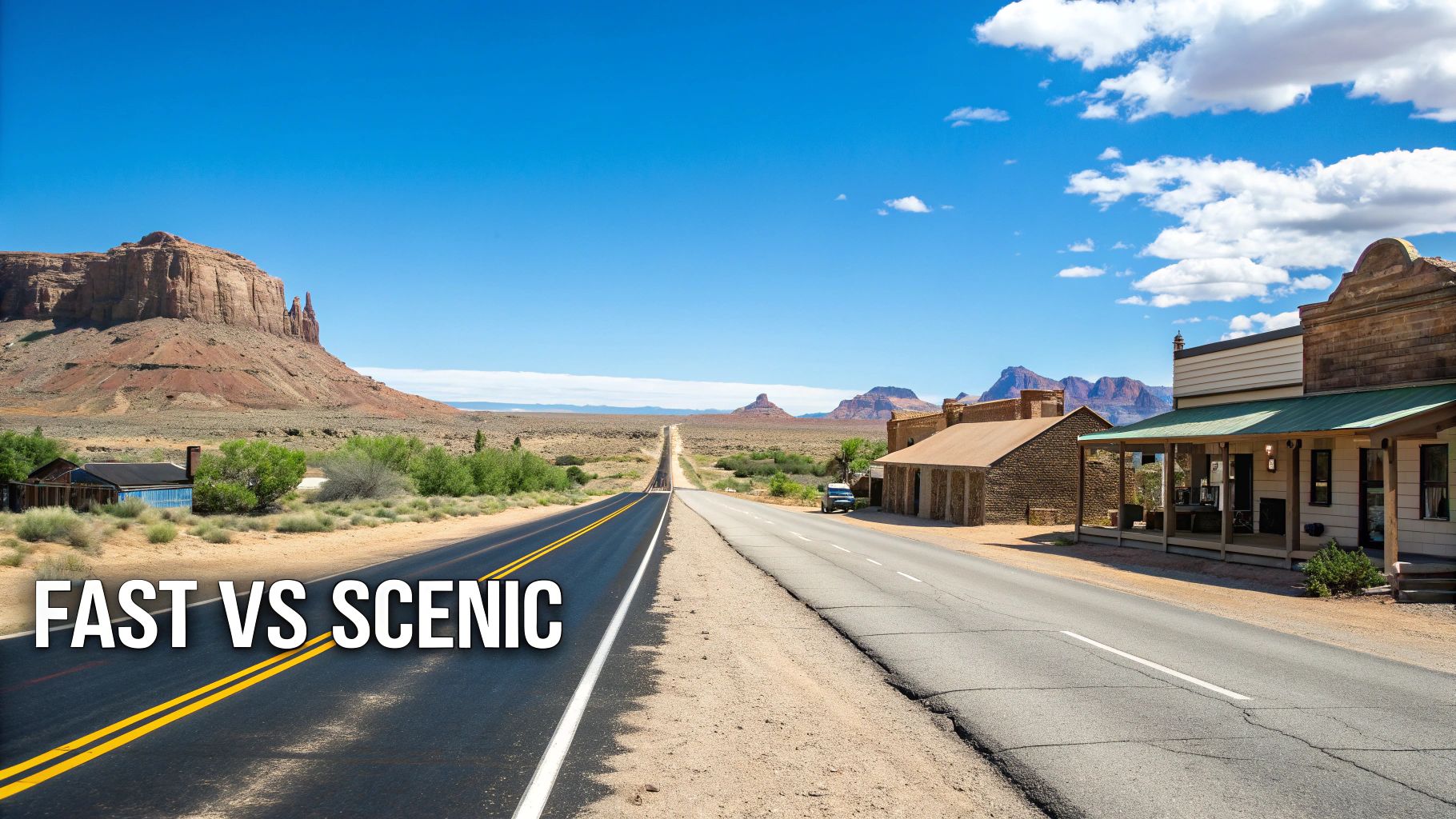
The drive from Las Vegas to Flagstaff forces you to answer a classic road trip question: do you want speed or story? It’s a trade-off between efficiency and experience, and there's no right answer—only what's right for your trip.
Most people aren't just passing through Flagstaff; they're headed there to settle in for a few days of mountain air. In fact, a whopping 84% of leisure travelers arrive by car, according to a recent Flagstaff tourism study. The real goal is to get there without feeling exhausted. For that reason, the direct route is the default for a reason. It just makes sense.
The Fast Way: US-93 to I-40
If your only goal is to get from the Vegas Strip to a brewery in downtown Flagstaff as fast as possible, this is your route. You'll take US-93 South out of Henderson and follow it until it merges with I-40 East in Kingman, Arizona. Easy.
It's a practical, predictable drive that clocks in around 4.5 hours without stops. The highway is well-maintained, you'll find gas and food at regular intervals, and you'll have a decent cell signal for most of the way. It’s not the most inspiring drive in the world, but it’s effective. This is the path you take when the destination matters more than the journey.
The Scenic Way: Historic Route 66
Then there's the romantic option—detouring onto a slice of Historic Route 66. This isn't the main highway anymore; think of it as a side quest. The most popular detour is the stretch between Kingman and Seligman. For the more adventurous, there's the Oatman Highway west of Kingman.
Last time I drove the Oatman Highway, I was stuck behind a massive motorhome crawling up the switchbacks at maybe 10 mph. My "quick scenic detour" turned into a slow, white-knuckle crawl. It's an experience, for sure, but make sure it's one you actually want. I definitely don't recommend driving it after dark—the sharp drop-offs and lack of lighting are a bad combination.
So, how do you decide?
- Take the fast route if you’re on a tight schedule, traveling with kids who will get antsy, or simply want to arrive in Flagstaff feeling fresh.
- Opt for the scenic route only if you have at least 2-3 extra hours to spare and a healthy dose of patience for slow speeds and unexpected delays.
Don't let the romantic idea of old-school road-tripping derail your schedule. This first decision sets the tone for your trip, so choose wisely.
Are the roadside stops actually worth your time?
Every travel blog spits out the same list of stops for the Vegas to Flagstaff drive. You know the ones: Hoover Dam, Route 66, maybe see some donkeys. But let’s be honest—not every stop is worth hitting the brakes for, especially if you’re trying to make good time.
Wasting a couple of hours at an overcrowded tourist trap can put a real damper on your trip. The trick is knowing which stops offer a genuine experience and which are just glorified photo ops.
Neighborhood Anchoring: The Hoover Dam Decision
The Hoover Dam is an engineering spectacle, no doubt. Seeing that massive concrete wall wedged into the Black Canyon is something else. But its proximity to Vegas also makes it a magnet for tour buses, which start rolling in around 10 AM.
If you want to experience the dam without feeling like you're in a theme park line, you have to be strategic. Get there before 9 AM. This timing tip gets you ahead of the big crowds, giving you space to walk the top, get your photos, and get back on the road before the parking lot turns into chaos. Don't even think about the full power plant tour unless you've budgeted at least three hours for the whole ordeal.
Kingman vs. Oatman: The Route 66 Dilemma
Once you cross into Arizona, you'll hit Kingman, which calls itself the "Heart of Historic Route 66." It’s a solid, practical place to fuel up and grab a bite. The Arizona Route 66 Museum here is actually a pretty good, quick hit of nostalgia. You can be in and out in under an hour.
Then you have Oatman. This old mining town is famous for its "wild" burros that wander the streets. While it's a unique sight, the reality can be frustrating. Oatman sits at the end of a narrow, winding highway with sharp drop-offs and basically no shoulder. The burros often block traffic, and it’s not uncommon to get stuck behind a slow-moving RV for miles.
The WanderAssist Reality Check: Price & Time Warning
Deciding where to stop often comes down to balancing your wallet and your watch. Here’s a breakdown to help you choose.
| Stop | Average Time Needed | Typical Cost (per person) | The Honest Take |
|---|---|---|---|
| Hoover Dam | 1-3 hours | $10 (parking) to $30+ (tour) | Go early (before 9 AM) to avoid the massive crowds. |
| Kingman | 45-60 minutes | Free to $4 (museum) | The perfect quick stop for a dose of history and a tank of gas. |
| Oatman | 2-3 hours (incl. detour) | Free (plus cost of burro food) | Tourist Trap Warning: A quirky but time-consuming detour on a challenging road. Skip if you're on a schedule. |
| Williams | 30-90 minutes | Free (unless you eat/shop) | A good spot for lunch, but Flagstaff offers more for an overnight. |
This isn't about seeing everything; it's about seeing the things that will actually add to your road trip experience without causing unnecessary stress.
Williams: Lunch Stop or an Overnight Stay?
About an hour from Flagstaff, you’ll roll through Williams, the "Gateway to the Grand Canyon." It has a well-preserved main street that fully embraces its Route 66 and railroad heritage. It's an excellent place to stretch your legs and grab some lunch.
But is it worth staying the night? I’d say no, not unless you have tickets for the Grand Canyon Railway the next morning. Flagstaff is just an hour further down the road and has a much better selection of restaurants and breweries. My advice? Use Williams as your final pit stop, fill up the tank, and push on to your actual destination.
If you find this kind of no-nonsense planning helpful, our guide on the Las Vegas to Bryce Canyon drive offers a similar approach.
What's a practical itinerary I can actually use?
Let’s get down to it. Most travel guides just throw a list of stops at you. That’s not a plan. Here are two solid, time-blocked itineraries for the drive from Vegas to Flagstaff.
Think of these less as rigid schedules and more as proven frameworks. The point is to get you to Flagstaff feeling refreshed, not frazzled. If you're tired of the decision fatigue that comes with trip planning, the WanderAssist 60-second planner is designed to solve exactly that problem.
The One-Day Blitz
This itinerary is for anyone who needs to be efficient but still wants to see the main sight along the way. The goal is simple: get checked into your Flagstaff hotel by late afternoon, stress-free.
- 7:00 AM: Wheels up from Las Vegas. This is non-negotiable. It’s your ticket to beating the city’s outbound traffic and, more importantly, arriving at Hoover Dam before the big tour buses.
- 7:45 AM - 9:00 AM: Hoover Dam stop. Park, walk across the top, and just take in the sheer scale of it. Get your photos, feel the desert wind, and then get moving. To stay on schedule, skip the full guided tour.
- 11:00 AM (Arizona Time): Lunch in Kingman. Right after crossing into Arizona, you’ll lose an hour. Kingman is the perfect spot to refuel both your car and yourself. A quick stop at Mr. D’z Route 66 Diner gives you the nostalgic vibe without eating up your afternoon.
- 12:30 PM: Back on I-40 East. The final stretch is a straight shot through the high desert. This is where you make up time.
- 3:00 PM: Arrive in Flagstaff. This timing is perfect. You can check in, drop your bags, and still have the entire late afternoon to explore.
Local's Tip: Once you're settled, head straight for the historic downtown. It's compact and walkable. Grab a pint at a local brewery like Mother Road Brewing Company and wander around Heritage Square. It's the best way to immediately tap into the city's relaxed, mountain-town energy.
The Overnight Explorer
If you’ve got more time, breaking the drive into two days transforms it from a commute into a genuine road trip. This lets you dive into the historic Route 66 detours without constantly checking your watch.
Day 1: Vegas to Williams (Approx. 3.5 hours driving)
- 9:00 AM: Leave Las Vegas. No crack-of-dawn start needed here.
- 10:00 AM - 11:30 AM: Hoover Dam. Enjoy a more leisurely visit.
- 1:30 PM (AZ Time): Kingman. Grab lunch and spend an hour at the Arizona Route 66 Museum.
- 3:00 PM - 5:00 PM: Drive the best scenic stretch of Route 66, from Kingman to Seligman. This is the fun part. Stop at the quirky Hackberry General Store.
- 6:00 PM: Arrive in Williams. Check into your hotel and soak up the vintage Americana feel of the town.
Day 2: Williams to Flagstaff (Approx. 1 hour driving)
- Morning: Enjoy a slow start in Williams. Walk the main strip, pop into the shops, and maybe watch the Grand Canyon Railway chug out of the station.
- 11:00 AM: Depart for Flagstaff. It's a short, easy drive.
- 12:00 PM: Arrive in Flagstaff. You’ll get there with a full day ahead to explore.
This visual gives you a quick sense of how the main stops are laid out.
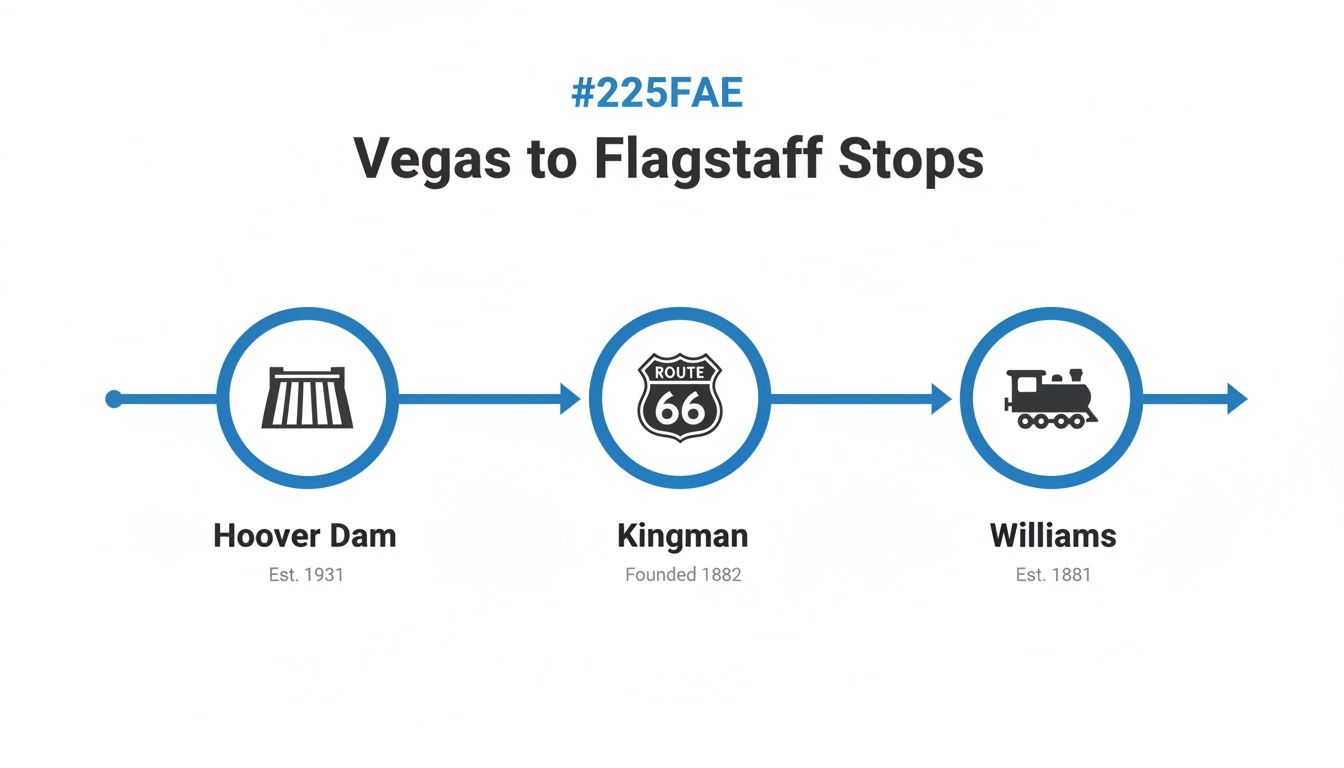
As you can see, the stops are clustered logically, making it easy to progress. You won't be alone on this route. Flying directly into Flagstaff can be surprisingly expensive, pushing more people to choose the more economical drive. If you're struggling to organize all these details, our guide on how to create a travel itinerary has more strategies to help.
What if I don't feel like driving?
Let's be real—navigating desert highways isn't for everyone. Maybe you want to kick back with a podcast or just avoid the stress of being behind the wheel. If you'd rather leave the driving to someone else, you have a couple of solid choices.
The most common alternatives are shuttle services. Companies like Groome Transportation and FlixBus are the main operators on this route. They run pretty consistently and are definitely the most budget-friendly way to get there besides your own car.
Just set your expectations. This isn't a first-class experience. The comfort level is basic, the onboard Wi-Fi can be spotty, and the journey will almost always take longer than a direct drive—expect around 5.5 to 6 hours after stops and traffic.
Shuttles vs. Rideshare: The Real Cost
For solo travelers or anyone on a budget, a shuttle is the clear winner. The ticket price is predictable. Rideshare services like Uber and Lyft are a whole different story.
Sure, you can technically request an Uber from Las Vegas to Flagstaff. But finding a driver willing to accept a 250-mile, four-hour-plus trip is incredibly rare. Even if you get lucky, the fare will be staggering.
Price Warning: You're easily looking at a $300 to $500+ bill for a one-way Uber or Lyft on this route, before surge pricing. The driver has to drive all the way back to Vegas, likely without a passenger, so they bake that cost into your fare.
So, which one should you choose?
Here’s a simple breakdown:
-
Groome Transportation or FlixBus: This is your best bet for saving money. It's a no-frills, practical way to get from point A to point B without driving. Just pack some snacks, download your entertainment ahead of time, and you'll be fine.
-
Uber or Lyft: Honestly, this only makes sense in an absolute emergency or if a group is splitting a massive fare and all other options have failed. It’s just not a practical or affordable choice.
At the end of the day, the savings from a bus ticket almost always outweigh the extra travel time. If you're finding it tricky to juggle these logistics, using the best AI travel planner can help map out all your options and streamline decisions.
What do most guides leave out?
<iframe width="100%" style="aspect-ratio: 16 / 9;" src="https://www.youtube.com/embed/K_MdA2pL41A" frameborder="0" allow="autoplay; encrypted-media" allowfullscreen></iframe>Let's get real about what most guides skip. On paper, it looks like a straightforward four-hour desert drive. It’s not. What you’re really in for is a journey through dramatically shifting landscapes that can catch you off guard.
You’ll start in the Mojave Desert, where the heat can be punishing, and then steadily climb into the high-altitude pine forests surrounding Flagstaff at 7,000 feet. That elevation gain means the weather can change in a heartbeat. I can't tell you how many times I've left Vegas in the sun only to find myself driving through a wild thunderstorm as I neared the San Francisco Peaks.
The WanderAssist Reality Check: Price Gouging and Dead Zones
Here’s a pro tip that’ll save you some cash: fill up your gas tank before you leave Nevada. The second you cross into Arizona, you’ll see gas prices jump by 30 to 50 cents per gallon. Topping off your tank in a town like Henderson is one of the smartest moves you can make.
You also need to prepare for long, empty stretches of road. The segment between Kingman and Williams, for example, has very few places to stop for gas or food.
Last time I made this drive, I spotted three separate highway patrol cars tucked away just waiting for drivers to get too comfortable on the long, straight road. They know people get complacent out here, so watch your speedometer.
And perhaps most importantly, your cell signal will be unreliable. It will go from spotty to non-existent for long periods. Download your maps and playlists before you leave Vegas. Having a gallon of water in the car isn't just a friendly suggestion—it's an absolute necessity.
What are the most common questions about this drive?
Let's get right to it. Here are the practical, no-nonsense answers to the questions I hear most often about the drive from Vegas to Flagstaff.
How bad is the traffic leaving Las Vegas?
Honestly, it can be a real nightmare. If you hit the road at the wrong time, you’re setting yourself up for a frustrating crawl.
Friday afternoons and holiday weekends are the absolute worst. Trying to leave then is a guaranteed way to add at least an extra hour of stop-and-go traffic to your trip, especially around the I-15 interchanges.
Timing Tip: Your best bet is to leave before 7 AM or wait until after 7 PM. A midday departure just throws you into the peak of the chaos.
Is it safe to drive from Vegas to Flagstaff at night?
For the most part, yes, it's safe. The main route via US-93 and I-40 is a major highway system, so you don't have to worry about the road quality.
That said, vast stretches of this drive are through unlit, open desert. Your biggest hazard at night is wildlife. As you get closer to Flagstaff, the chances of encountering deer or elk on the road increase significantly. Stay alert.
One thing I'll say is this: do not take the scenic detours like the Oatman Highway after dark. The hairpin turns, steep drop-offs, and total lack of lighting make it a dangerous gamble.
Do I need a special vehicle for this drive?
Nope, not at all. Your standard car will do just fine. The entire primary route is paved and generally in great shape, so you don't need an SUV or 4x4.
The one major exception is winter. Flagstaff is at 7,000 feet, and it gets serious snow. Always check the forecast before you leave Vegas. A sudden storm can make I-40 incredibly icy and can even lead to road closures. In those conditions, you might need a vehicle with snow tires or chains.
Tired of sifting through endless advice and trying to piece together a coherent plan? WanderAssist builds a realistic, time-blocked itinerary for your trip in under 60 seconds, so you can stop planning and start traveling. Create your free plan on wanderassist.com and experience the road trip without the stress.