
New York in October: Is It Actually Worth The Hype?

Planning a trip to New York in October? Get a practical guide on weather, crowds, and a realistic itinerary that skips the usual tourist traps.
Here’s the truth about visiting New York in October: it’s great, but it’s not the quiet, cheap shoulder season some guides promise. The weather is crisp, but the crowds are thick, and your wallet will feel it. The secret to a good trip is anchoring each day in one walkable neighborhood to avoid spending your vacation on the subway.
Is New York Crowded in October?
Yes, absolutely. Forget racing from the Statue of Liberty to the Met and then to Brooklyn in a single day. That's just a recipe for burnout. My advice? Hit the big sights first thing in the morning to sidestep the worst lines. Then, spend your afternoons getting lost in places with more breathing room, like the West Village or a quiet corner of Central Park. This swaps tourist-trap exhaustion for actual discovery.
If you're already feeling the decision fatigue, a tool like the WanderAssist 60-second planner builds a schedule that won't burn you out.
October in NYC: The Real Numbers
To set your expectations straight, here’s a quick, no-nonsense summary of what you’re walking into.
| Metric | What to Expect |
|---|---|
| Average Weather | Days hover around 55-65°F (13-18°C), which is perfect for walking. Evenings get chilly fast. Expect sun, but pack for rain. |
| Crowd Levels | High. This is a peak month. Tourists and locals are all out, making the streets feel electric but packed. |
| Accommodation Costs | Expensive. Hotel prices are near their yearly high. Don't expect any last-minute deals. |
| Top Foliage | Peak fall colors usually hit in the last two weeks of October. Central Park and Fort Tryon Park are the best bets. |
Knowing this helps you plan smarter, pack better, and have a much better trip.
What Does October in NYC Actually Feel Like?
Forget the generic postcard images for a second. New York in October is about specifics. It's the way that low autumn light hits the brownstones in Greenwich Village, the smell of roasted nuts from a street cart mixing with the crisp air, and the sound of dry leaves crunching under your feet in Central Park.
The weather isn't just "pleasantly cool"—it's a bit of a trickster. A sunny 65°F (18°C) afternoon can feel perfect, but the moment the sun dips behind the skyline, that temperature can plummet to a windy 45°F (7°C). Last time I was there in October, I made the classic mistake of leaving my hotel for an evening walk without a real jacket and learned a freezing lesson in about ten minutes flat.
Layers aren't a suggestion; they are your survival strategy.
The City's Shifting Rhythm
You also need to factor in the shortening days. That "golden hour" light photographers love happens much earlier, and by 6 PM, it’s fully dark. This means you have to schedule outdoor plans, like walking the Brooklyn Bridge or exploring a park, for earlier in the afternoon if you want the best light.
This is the October trade-off: the weather is about as good as it gets, but you'll be sharing the city with a lot of other people, and your wallet will notice.
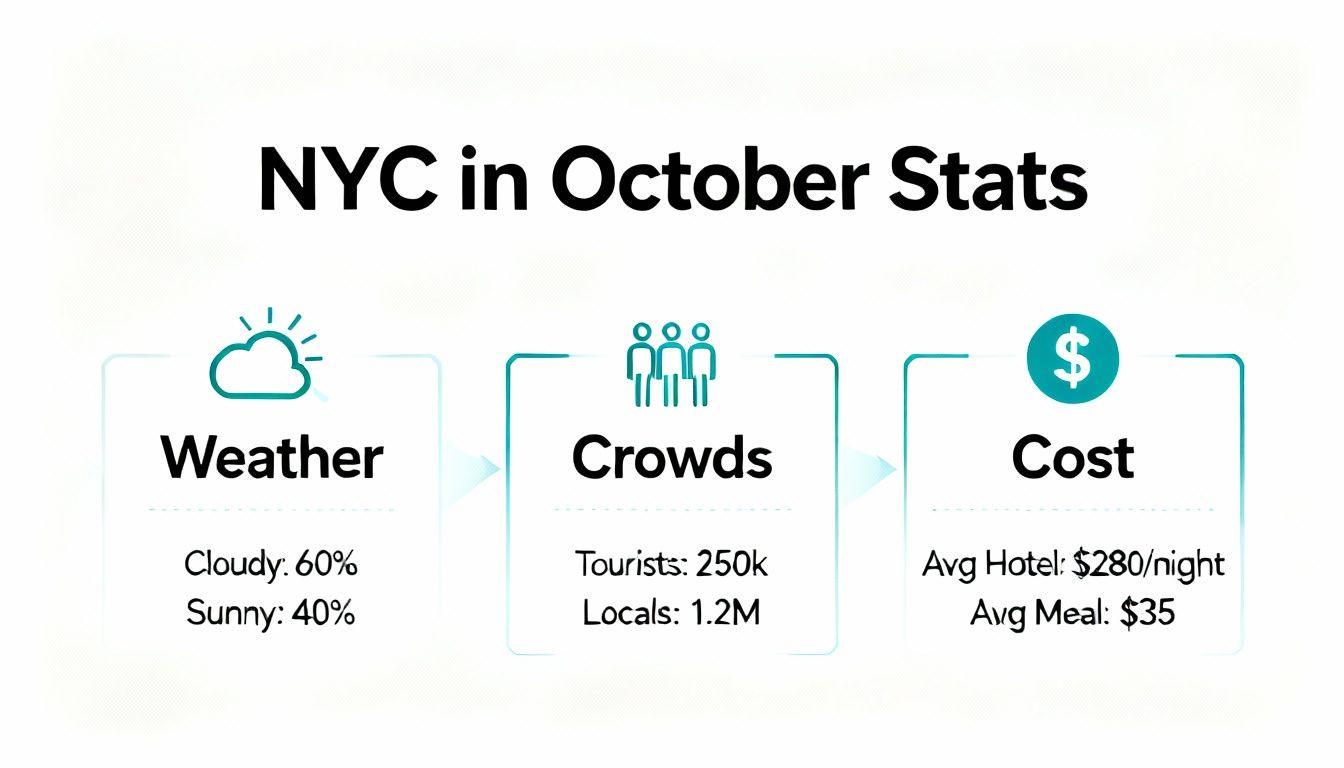
The takeaway is clear. While the weather is at its peak, so are the crowds and costs. Smart planning isn't just nice to have; it's essential.
Why Does October Feel So Busy?
That packed feeling isn't in your head. October kicks off the fall tourist season with a huge surge in people. For instance, foot traffic in hotspots like Times Square recently jumped 8.5% compared to the previous year, signaling the end of the summer lull.
Hotels reflect this demand. Occupancy rates often climb to 94% by late October, with average daily rates hitting $414. This isn't some quiet shoulder season; it's a prime-time month. You can dig into more tourism trends over on City Guide NY.
How Do You Structure Your Days to Avoid Burnout?
The biggest mistake first-timers make is treating the city like a frantic to-do list. They’ll try to hit a museum in Midtown in the morning and then rush downtown for a ferry in the afternoon. That's a classic recipe for exhaustion, sore feet, and wasted time on the subway.
NYC is too big, and getting between boroughs takes longer than you think. You need a smarter strategy. I call it "Neighborhood Anchoring," and it’s the secret to actually enjoying the city without getting steamrolled by it.

The idea is simple: pick one, or at most two, adjacent neighborhoods for each day. This slashes your travel time and gives you more hours to actually experience things. It turns your trip from a frantic race into a collection of local deep dives. If you're struggling to picture it, our guide on how to plan a trip itinerary breaks down how to structure your days.
What Does Neighborhood Anchoring Look Like?
It just means thinking geographically. Here are a few examples of perfectly anchored days:
- Downtown Day: Start your morning wandering the quiet, cobblestoned streets of the West Village. Grab lunch in the Meatpacking District, and then spend the afternoon walking the High Line north into Chelsea. Everything is connected and easily walkable.
- Uptown Museum Day: Dedicate your day to the Upper West Side and Upper East Side. You could kick things off at the American Museum of Natural History, then stroll across Central Park for an afternoon on Museum Mile, hitting the Met or the Guggenheim.
- Brooklyn Waterfront Day: Zero in on the area around the Brooklyn Bridge. Explore DUMBO's waterfront, get lost in the historic brownstones of Brooklyn Heights, and then walk the bridge back to Manhattan as the sun sets.
This forces you to slow down. You’ll start noticing the little bakeries, the local parks, and the cool architecture you’d miss if you were just sprinting between landmarks.
What Is Temporal Logic?
This strategy is even more powerful when you pair it with what I call "Temporal Logic"—thinking about when you visit a place, not just where. Popular indoor spots, like major museums, are always less chaotic on a weekday morning. Iconic outdoor areas like the Brooklyn Bridge or Times Square are often more pleasant on a weekday evening after the daytime tourist swarms have thinned out.
By combining neighborhood anchoring with smart timing, you stop fighting the city’s rhythm and start working with it.
Can I Get a Realistic 3-Day Itinerary?
<iframe width="100%" style="aspect-ratio: 16 / 9;" src="https://www.youtube.com/embed/TT2R5B9F3EQ" frameborder="0" allow="autoplay; encrypted-media" allowfullscreen></iframe>Alright, let's put neighborhood anchoring into action. This isn’t a frantic checklist. Think of it as a blueprint for a realistic 3-day trip that lets you actually experience New York in October. The goal is immersion, not a race.
We're building this plan around one rule: less time on the subway, more time on the ground. It intentionally leaves room to breathe and discover your own "Linger Zone"—that perfect park bench or quiet cafe where you can just sit back and watch the city unfold.
Day 1 Anchors: Downtown and the Lower East Side
The first day is all about classic downtown Manhattan, but at a pace that feels enjoyable.
-
Morning (9 AM - 1 PM): SoHo & Nolita. Start your day with window shopping through SoHo's cast-iron district. Honestly, the architecture is the real star here. An early start means you'll beat the worst of the crowds that choke these narrow streets by midday. Wander east into Nolita for lunch for a less chaotic vibe.
-
Afternoon (2 PM - 6 PM): Lower East Side. The main event is the Tenement Museum. You must book this in advance, but it’s one of the most powerful historical experiences in the city. It's a raw look into the lives of immigrants and a great counterpoint to SoHo's modern gloss.
-
Linger Zone: Find a cafe on Elizabeth Street in Nolita. It’s the perfect spot to grab a coffee, rest your feet, and people-watch as the neighborhood hums around you.
Day 2 Focus: Uptown and Central Park
Today, we head north to balance one of the world's great museums with the city's most iconic green space.
-
Morning (9 AM - 1 PM): Central Park's Ramble. The Ramble is a 36-acre "wild garden" inside Central Park, and in October, it’s a masterpiece of fall foliage. The key is to go early. An 8:30 AM or 9 AM start means you'll be sharing the winding paths with local dog walkers, not massive tour groups.
-
Afternoon (2 PM - 6 PM): The Met. After grabbing a bite from a food cart, it’s time for The Metropolitan Museum of Art. Here's the secret: you can't see it all, so don't try. Pick two or three exhibits that genuinely interest you—maybe Egyptian Art and the Arms and Armor collections—and give them your full attention.
-
Linger Zone: The steps of the Met. It’s a cliché for a reason. Sit for 20 minutes and just watch the stream of people and yellow cabs flow down Fifth Avenue.
Day 3 Perspective: A Brooklyn Deep-Dive
For our final day, we're crossing the river to get a completely different perspective on the city.
-
Morning (10 AM - 1 PM): DUMBO & The Waterfront. Hop on the subway to DUMBO. The immediate payoff is the iconic view of the Manhattan Bridge framed by the buildings on Washington Street. From there, wander over to Main Street Park for skyline views. The crisp October air off the East River feels incredible.
-
Afternoon (2 PM - 6 PM): Brooklyn Heights. From DUMBO, walk up the hill into Brooklyn Heights. This neighborhood is a quiet collection of historic brownstones that feels a world away from Manhattan. Your destination is the Brooklyn Heights Promenade, a walkway with sweeping, cinematic views of the downtown skyline.
-
Linger Zone: Find a bench on the Brooklyn Heights Promenade. As the afternoon light hits the skyscrapers of the Financial District, you’ll understand why this is one of the most cherished views in the city.
Sample 3-Day Neighborhood-Anchored Plan
This table shows how anchoring your days minimizes travel time and lets you explore more deeply without feeling rushed.
| Day | Morning Anchor (9am-1pm) | Afternoon Anchor (2pm-6pm) | Linger Zone |
|---|---|---|---|
| 1 | SoHo & Nolita | Lower East Side & Tenement Museum | Nolita cafe |
| 2 | Central Park Ramble | The Metropolitan Museum of Art | Steps of the Met |
| 3 | DUMBO Waterfront | Brooklyn Heights & Promenade | Promenade bench |
This rhythm—explore, absorb, then relax—is the key to a trip that feels restorative instead of draining. If this approach makes sense to you, you can build out more schedules using a day-by-day trip planner.
The WanderAssist Reality Check
Alright, let's talk about the stuff that can ruin your trip if you aren't prepared for it. Think of this as the advice a friend who lives here would give you.
The Myth of City-Wide Fall Foliage
That postcard image of every street in Manhattan bursting with fiery red and gold? It's mostly a fantasy. While you'll find spectacular pockets of color, peak foliage is a fickle, fleeting thing. Central Park and Fort Tryon Park? Absolutely stunning. But you won't see that same explosion of color on every block downtown. The peak usually hits in the last two weeks of October, but a single windy storm can strip the trees bare overnight. Come for the vibe, and treat perfect fall leaves as a bonus.
Price Warning: This Is High Season
Let's be crystal clear: October is one of the most expensive months to visit New York City. Full stop. It's a perfect storm of great weather, leaf-peeping tourists, and big conventions that sends flight and hotel prices skyrocketing. Don't mistake this for a quiet "shoulder season." It's peak season pricing with a fall jacket. If you haven't booked your hotel and flights at least three to four months out, expect to pay a serious premium. Last-minute deals are a myth this time of year.
Is the Halloween Parade Actually Fun?
The Greenwich Village Halloween Parade is a New York institution, but it's also a masterclass in organized chaos. The crowds are massive, dense, and can feel incredibly overwhelming. Once you're in the thick of it on Sixth Avenue, good luck getting out. Honestly, unless you truly live for the thrill of a shoulder-to-shoulder crowd, trying to "pop by" the parade usually ends with you stuck in a human traffic jam, seeing very little. My advice? Skip it.
What Should I Pack and How Do I Get Around?
Okay, let's talk logistics. Figuring out what to pack for October in NYC isn't about style; it's about being strategic so you can stay comfortable and dry. I can’t tell you how many times I've seen tourists shivering in thin coats after a cold front rolls in. Trust me, being prepared makes all the difference.

Your Essential October Packing List
Think of your packing list as a system. Here are the non-negotiables:
- A Packable Down Jacket: Your secret weapon for warmth. It's light enough to cram into a daypack but a lifesaver when the temperature plummets after dark.
- A Waterproof Outer Shell: And I mean truly waterproof, not just "water-resistant." October can bring anything from a drizzle to a downpour.
- Waterproof Boots: Make sure they are comfortable and, most importantly, already broken-in. You’ll be walking a ton, and blisters will ruin your plans.
- Beanie and Gloves: You might feel silly packing them, but you’ll be glad you have them when you're walking across the Brooklyn Bridge at night.
For a more exhaustive checklist, our complete list for packing for a trip has you covered.
How Do I Use the Subway?
For getting between boroughs, the subway is king. Don't bother with MetroCards; the system now runs on OMNY. It’s a contactless system—just tap your credit card or phone at the turnstile to pay. It’s that simple.
Crucial Tip: You will lose cell service the second you go underground. Before you leave your hotel, download an offline map to your phone. Citymapper is great for this. Trying to navigate a transfer with no signal is a classic tourist trap.
A quick word on taxis and ride-sharing apps: they are almost always a bad idea in Manhattan. Traffic is brutal, making them slow and expensive. Stick to the subway and your own two feet.
A Few Final Questions About October in NYC
Let's quickly tackle some common questions to sidestep any last-minute headaches.
Is The Columbus Day Parade Worth Seeing?
Honestly? For most visitors, it's more of a logistical nightmare than an event. Unless you have a personal reason to go, the parade mainly snarls traffic and makes getting around Midtown a massive challenge. Most locals I know actively plan to be somewhere else.
How Far In Advance Should I Book My Hotel?
Book it at least three months out. I can't stress this enough. October is absolute peak season. If you wait, you're looking at eye-watering rates and slim pickings.
What’s The Best Plan For A Rainy Day?
The moment it rains, every tourist makes a mad dash for the same handful of major museums. The result? The Met and MoMA become incredibly crowded. My advice is to zag while everyone else zigs. Go for the smaller, more specialized museums that are just as fascinating but way more manageable.
- The Frick Collection: This place is a gem. You're essentially walking through a Gilded Age mansion, surrounded by an incredible private art collection.
- The Morgan Library & Museum: Originally the personal library of financier J.P. Morgan, it’s an awe-inspiring space with a world-class collection of rare books and art.
- A Classic Movie House: Duck into a historic cinema like the Angelika Film Center or Film Forum for a few hours.
This simple move helps you escape the rain and the worst of the crowds.
Pulling together a trip this detailed can feel like a full-time job. If you want a fast, reality-checked itinerary that avoids the tourist traps and respects your time, check out the WanderAssist 60-second planner at https://wanderassist.com.