
How to Build a Custom Travel Itinerary That Doesn't Suck

Stop using generic travel plans. Learn to build a custom travel itinerary that avoids crowds, saves time, and lets you experience a city like a local.
A good custom travel itinerary is your battle plan against burnout, not a checklist of tourist spots. Building one means skipping the midday heat at the Pantheon and anchoring your days in walkable districts to avoid transit fatigue. This guide shows you how to plan a trip that prioritizes real experiences over a frantic race to see everything.
Why is Your Current Travel Planning Broken?
Here's the truth: the standard way most of us plan a trip is flawed. We spend hours scrolling blogs, creating a huge list of places we feel obligated to see. The result? You end up zig-zagging across a city, spending more time on a packed subway than actually enjoying where you are.
Last time I was in Rome, I made this exact mistake. I had the Trevi Fountain on my list and showed up at 2 PM on a sweltering July afternoon. It was a mess. The heat was intense, the noise was a wall of tour guides shouting over each other, and you couldn't get within 50 feet of the fountain without fighting a forest of selfie sticks. I was there, but I wasn't experiencing it. That's when I realized: when you go is just as critical as where you go.

What's the Real Cost of Bad Planning?
This isn't just about avoiding frustration; it's about a huge shift in how people want to travel. The market for personalized travel is exploding, set to jump from $144.45 billion in 2024 to a projected $317.4 billion by 2029.
Why? Because travelers are getting smarter. A whopping 74% of travelers now want itineraries that match their actual interests, not some generic top-ten list they found online.
An effective custom itinerary is built on two simple ideas:
- Temporal Logic: This just means you schedule things to avoid the worst of the crowds. It means hitting that famous landmark in the late afternoon after the tour buses have cleared out, not right in the middle of the midday rush.
- Neighborhood Anchoring: Instead of bouncing all over town, you group your plans by walkable districts. This trick drastically cuts down on travel fatigue and lets you sink into the vibe of one area at a time.
The goal isn't to see more; it's to experience more with less stress. A great itinerary recognizes that the best moments happen when you aren't frantically rushing to the next thing on your list.
This mindset is key, whether you're mapping out a huge international trip or just figuring out how to plan a weekend getaway without it feeling like a chore.
So, What’s the Difference Between Generic and Smart Planning?
To see the difference, let’s compare the old way of doing things with a smarter approach. The contrast is stark.
| Planning Element | Generic Itinerary (The Problem) | Smart Custom Itinerary (The Solution) |
|---|---|---|
| Activity Grouping | Based on a random checklist of sights. | Neighborhood Anchoring: Grouping by walkable districts. |
| Timing & Scheduling | Ignores crowd patterns, leading to midday chaos. | Temporal Logic: Scheduling around peak hours to avoid the worst of it. |
| Pacing | Jam-packed and rigid, leaving no room for spontaneity. | Flexible "Linger Zones": Building in downtime for discovery. |
| Travel Time | Wasted hours zig-zagging across the city on public transport. | Minimized by exploring one area at a time. |
| Overall Goal | To "see" as much as possible, leading to burnout. | To experience more deeply with less stress and wasted effort. |
By prioritizing smart timing and location over a simple list, you solve the biggest travel headaches from the start: decision fatigue and wasted time.
Can You Get Real About Your Trip's Purpose Before Booking?
Before you even look at flights, you need to have an honest conversation with yourself: Why are we even going on this trip?
This isn't about the destination. It's about the intent. Nailing this down is the single most important step. Get it wrong, and you’ll end up with an itinerary that looks great on paper but feels like a total drag.
Forget the generic idea of a "vacation." What are you really after? Are you desperate to escape burnout and just need permission to do nothing? Or are you a die-hard foodie on a mission to hit three specific restaurants you've been stalking online?
This core purpose is your compass. It dictates every choice you make from here on out. Without it, you’ll just default to a tourist checklist.
What Does a Real-World Trip Goal Look Like?
A good trip goal is specific enough to act as a filter. It’s not a vague wish like "see Paris." It’s a mission statement that gives you the power to say "no."
Here are a few examples of what I mean:
- For a Couple: "Our goal is to have two great, unhurried dinners and spend zero time in museum lines. Afternoons are for sitting at sidewalk cafes, not racing between landmarks."
- For a Family: "We’ll hit one major landmark before 11 AM each day. After that, it’s all about a long lunch and serious park time. Success is defined by zero kid meltdowns."
- For a Solo Traveler: "I want to explore the city's independent bookshops and find the best espresso near each one. My main activity is just walking and observing."
When you define what a successful day looks like for you, you’ve already eliminated 80% of the decision fatigue that tanks most trips. This isn't about seeing less; it's about focusing on what actually matters.
This clarity is your secret weapon against an overstuffed schedule. When a friend insists you have to see a certain monument, your goal gives you the confidence to say, "That sounds interesting, but it doesn't fit the vibe of this trip."
If crafting the whole thing feels like a chore, a tool like the WanderAssist 60-second planner can build a schedule around your specific goal almost instantly.
Why Should You Anchor Your Days in Walkable Neighborhoods?
Let's be honest: bouncing around a city like a pinball is exhausting. The old way of making an itinerary—a checklist of famous sites scattered miles apart—is a recipe for tired feet and wasted time.
There’s a much smarter way. I call it Neighborhood Anchoring. The concept is simple: you group your activities by walkable districts, dedicating a morning, an afternoon, or even a full day to exploring one specific area before you hop on a bus or metro.
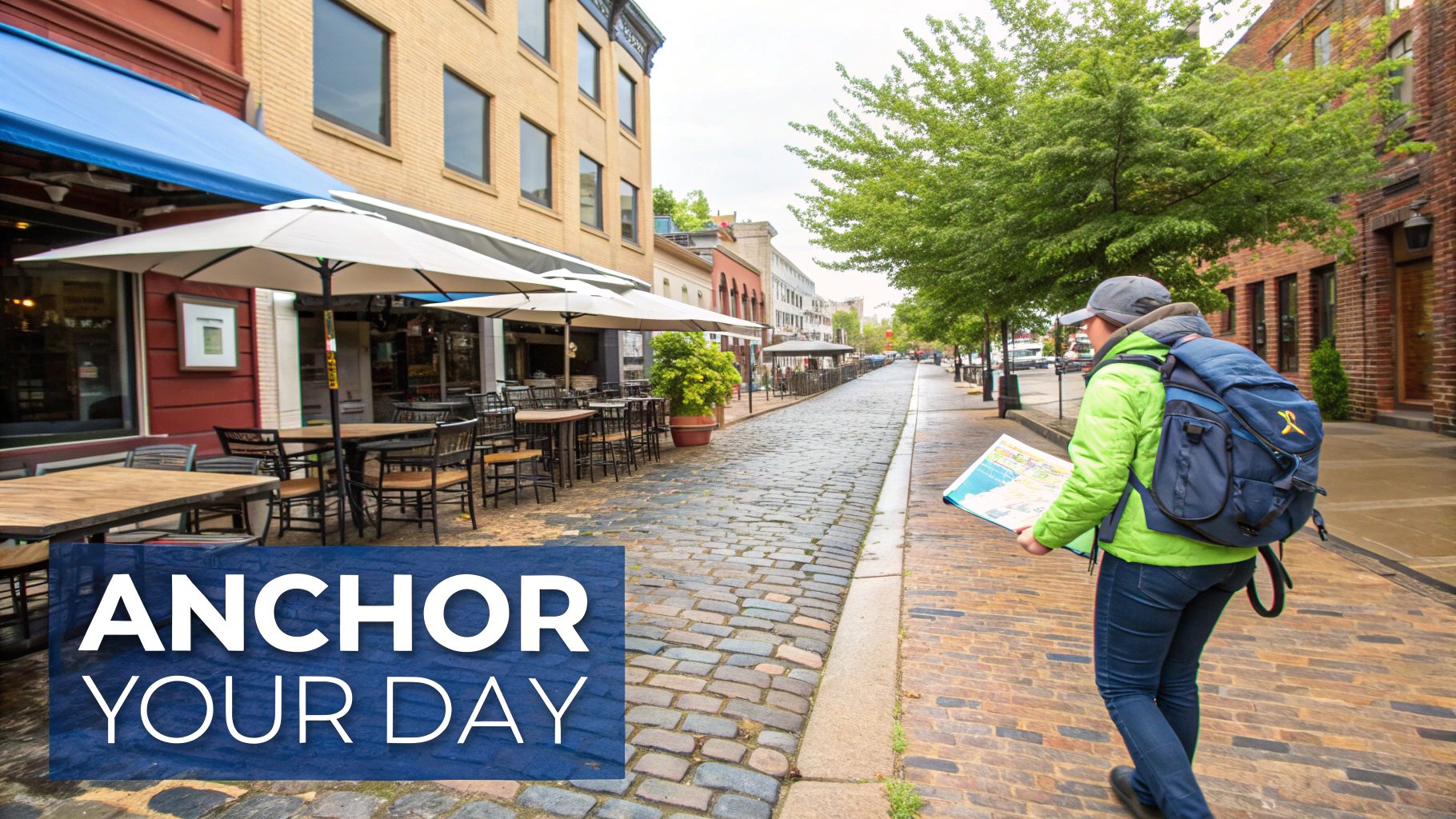
This one change saves hours of transit time. More importantly, it lets you soak in the character of each part of the city. Instead of just seeing landmarks, you get a feel for the local rhythm—the sound of morning deliveries on cobblestone streets, the smell of fresh pastries from a bakery, the buzz of locals heading home from work.
How Does This Work in a City Like Paris?
Let's take Paris. A classic, poorly planned trip might have you racing from the Louvre to the Eiffel Tower and then across town to Montmartre in a single day. That’s a logistical nightmare.
Now, imagine anchoring your day in a neighborhood like Le Marais. You could start your morning with a coffee at a sidewalk café, wander through the Place des Vosges, browse tiny shops, and grab lunch—all without needing a metro card. Your entire day is woven into the fabric of a walkable district.
You're not just checking boxes; you're living in a small part of the city for a day. This approach isn't just a niche trick; it's how modern travelers want to experience the world. The global online travel market is projected to hit $1,438.4 billion by 2034, and a huge reason why is that 74% of travelers are demanding personalized schedules that reflect their unique tastes, not cookie-cutter tours. You can dive deeper into these trends in the full research on the online travel market from IMARC Group.
How Do You Pinpoint the Right Anchor Neighborhoods?
The key is identifying the right hubs—those areas dense with a good mix of sights, food, and atmosphere.
Here’s a quick process I use to find them:
- Look for Clusters on a Map: Pull up a map of the city and see where points of interest naturally bunch together. Look for parks, markets, and interesting streets in the same general area.
- Identify the "Linger Zones": Find places that invite you to slow down. This could be a public square with benches, a scenic riverfront, or a street famous for its cafes.
- Check Transit Connections: Your anchor neighborhood needs to be easy to get to. A great anchor will have a central metro station or bus stop.
- Research the Vibe, Not Just the Sights: A quick search for a "Le Marais neighborhood guide" will tell you more about its character than a dry list of its attractions.
Building your day around a neighborhood instead of a checklist fundamentally changes the feel of your trip. It shifts the focus from "doing" to "being."
If this research sounds tedious, the WanderAssist 60-second planner is designed to do this for you. It automatically builds your days around these walkable districts, so you can focus on the experience.
How Can You Outsmart the Crowds with Better Timing?
<iframe width="100%" style="aspect-ratio: 16 / 9;" src="https://www.youtube.com/embed/utBko5G6udY" frameborder="0" allow="autoplay; encrypted-media" allowfullscreen></iframe>When it comes to travel planning, timing is your secret weapon. The common advice is to "go early," but that’s a rookie move. The real trick is to work against the flow of tourist traffic. I call this Temporal Logic.
It isn’t about dragging yourself out of bed at 6 AM. It's about outsmarting the tour buses. Think of a famous cathedral that's a madhouse from 10 AM to 3 PM. Now, picture it at 4:30 PM. The buses have left, the late afternoon sun is streaming through the stained glass, and you can actually hear your own footsteps. It’s a completely different world.
Is There a Simple Way to Structure Your Day?
The simplest way is by breaking the day into three distinct time slots. This isn't a rigid schedule, but a mental framework that changes how you piece together your day.
- Morning (8 AM - 11 AM): This window is gold for hitting spots that get swamped by midday. That famous local market? Go when the locals are actually there doing their shopping. You'll smell the fresh bread, not wade through selfie sticks.
- Midday (12 PM - 3 PM): This is when everyone else is queuing for the main event. You do the opposite. Use this time for things that aren't on every tourist's list. Enjoy a long lunch, wander down a quiet side street, or find a small, niche museum. It’s also the perfect time for a quick nap to fix jetlag.
- Evening (4 PM onwards): Now’s your chance to move in on the major landmarks. As the big tour groups head back to their hotels, you swoop in. This works wonders for famous squares, scenic viewpoints, and cathedrals with later hours.
This isn't just about skipping lines. When you shuffle your schedule this way, you see a city as it actually lives and breathes, not just as it performs for tourists.
This desire for less-crowded experiences is a huge trend. The travel market is projected to hit $1.67 trillion in 2026, and 74% of travelers are looking for personalized plans. We're seeing this play out globally, especially in the Asia-Pacific region, which now accounts for 31.8% of the online market. China's recent 80% explosion in outbound travel is fueling demand for itineraries that cleverly avoid the crush. You can discover more insights about these travel trends from Phocuswright.
Trying to manually figure out the crowd patterns for every site can feel like a full-time job. That's where the WanderAssist 60-second planner comes in. It's built on this logic, automatically arranging your day to feel relaxed and intelligent.
The WanderAssist Reality Check
Let's get real. A huge part of a smart itinerary is spotting a tourist trap from a mile away. It's not about being cheap—it's about being savvy.
Price Warning: The "Skip-the-Line" Ticket Myth
We need to talk about those "skip-the-line" tickets. For world-famous spots like the Colosseum, yes, you absolutely need to book in advance. But for second-tier museums or lesser-known landmarks? Those "premium access" passes are often a total rip-off. Last time I was in Florence, I watched a couple pay an extra €15 each for a "skip-the-line" pass to a smaller palace museum. The kicker? There was no line. They walked right in, just like I did with my standard ticket. Always do a quick search for recent reviews on wait times before you pay extra.
Price Warning: Airport Taxis vs. Local Transit
Another classic money pit is grabbing a taxi right outside the airport. You're tired, you've just landed, and it seems easy. But it's almost always the most expensive option. Take Rome: a taxi from Fiumicino Airport into the city can easily run you €50-€60. In contrast, the Leonardo Express train gets you to the main station faster and costs just €14. That's a €40+ difference before your trip has even really begun. A little pre-trip research on airport transport can save you enough money for a great dinner out.
The lesson is simple: walk 100 meters away from the main attraction, and watch the prices fall. It's this kind of on-the-ground decision fatigue that the WanderAssist 60-second planner is designed to solve, giving you smart, cost-aware options from the start.
What Does a Smart Itinerary Look Like in Action? A Lisbon Example
Theory is one thing, but seeing how these principles play out is where it all comes together. Let's map out a sample 3-day custom itinerary for Lisbon, putting everything we've discussed into practice.
Our travel goal is simple: "Experience Lisbon's historic core, enjoy great food, and avoid burnout from climbing all those hills."
A Smarter Plan for Lisbon
Forget the chaotic checklist. We're going to anchor each day in a specific, walkable district. This cuts down on travel time and fatigue.
-
Day 1 Anchor: Alfama We’ll kick things off at the Fado Museum right when it opens to enjoy the quiet. The afternoon is reserved for a "Linger Zone"—finding a little café for a coffee and watching the world go by. Come evening, we’ll head to a viewpoint like Miradouro das Portas do Sol after the big tour buses have left.
-
Day 2 Anchor: Belém This is a classic rookie mistake: go straight to the Jerónimos Monastery first thing. I'm serious. The lines here get monstrous by 10 AM. Once you’re done, you can take a relaxed stroll to the Belém Tower and then get the legendary pastries at Pastéis de Belém during the calmer afternoon lull.
-
Day 3 Anchor: Baixa-Chiado Let's use the morning to wander through the shops and Praça do Comércio. Midday is perfect for a long lunch at a place that catches your eye. You'll notice this day is intentionally lighter; it’s designed to leave room for spontaneous discoveries.
This is all about setting realistic expectations to avoid common travel headaches.

Moving from a vague expectation to a smart choice is how you prevent disappointment. Let's break down that Belém day to see how time-blocking creates a better flow.
Sample 1-Day Lisbon Itinerary (Belém District)
Here’s a look at how neighborhood anchoring and timing creates a perfectly paced day.
| Time Block | Activity | Reality Note |
|---|---|---|
| 8:30 AM - 9:30 AM | Travel & Coffee | Take the tram to Belém. Grab a coffee and pastry at a local spot near the monastery. |
| 9:30 AM - 11:30 AM | Jerónimos Monastery | Be in line before it opens at 9:30 AM to beat the massive tour groups. |
| 11:30 AM - 1:00 PM | Discoveries Monument & River Walk | A gentle walk along the Tagus River to the monument. Great for photos. |
| 1:00 PM - 2:30 PM | Relaxed Lunch | Find a restaurant away from the main tourist drag for a more authentic, peaceful meal. |
| 2:30 PM - 4:00 PM | Belém Tower & Pastries | The tower crowds are lighter now. Afterward, hit Pastéis de Belém when the lunch rush is over. |
| 4:00 PM onward | Linger Zone or Return | Wander through the gardens, visit the Coaches Museum, or head back to the city center. |
See the difference? No rushing, no backtracking. Just a logical, enjoyable flow.
This structured-but-flexible approach is the secret to a great custom itinerary. It gives you a solid framework but leaves plenty of breathing room.
Of course, putting this kind of plan together manually takes some effort. If you're looking for a shortcut, you can learn more about how technology can help in our guide to using an AI travel planner. The right tool can build a smart plan like this in seconds.
Your Itinerary Planning Questions, Answered
Still have a few questions? Good. A little skepticism separates a tourist from a savvy traveler. Let's get straight to the answers for the most common hang-ups people have.
How Much Should I Realistically Plan for Each Day?
Honestly, less than you think. One of the biggest mistakes is cramming your schedule. That’s a surefire recipe for burnout.
A much better approach is to plan just one major activity for the morning and one for the afternoon or evening. Treat everything else as a "Linger Zone"—that unscheduled time for a long lunch, an impulsive detour down a side street, or people-watching from a park bench. Over-planning is the quickest way to kill the fun.
What’s the Secret to Staying Flexible?
Flexibility isn't about ditching the plan; it's about having a plan that's smart enough to bend. This is where Neighborhood Anchoring shines.
When you group your day's activities in one walkable area, shuffling them around becomes effortless. If the museum you planned to visit is mobbed, you can just wander over to that cool café nearby and circle back later. Your whole day doesn't fall apart because of one hiccup.
A rigid itinerary is fragile. A neighborhood-anchored itinerary is resilient. It gives you a home base for the day, which makes spontaneous changes feel easy.
But What If I Just Hate Planning?
You're not alone. The sheer effort of researching, cross-referencing opening times, and mapping routes can feel like a part-time job. This is why tools that do the heavy lifting are no longer a luxury—they’re essential.
Instead of losing hours to a dozen different blogs, you can just set your trip's goal and let a smart planner handle the logistics. The point is to automate the tedious work so you can get back to the exciting part: dreaming about the experience itself.
Stop wrestling with spreadsheets and endless browser tabs. The WanderAssist 60-second planner builds a smart, reality-aware itinerary based on all the principles we’ve covered. Get a plan that works, instantly. Try it now at https://wanderassist.com.