
A Realistic Guide to Your Canada Road Trip
Plan a better Canada road trip. Get practical advice on routes, timing, and budgets from a seasoned traveler to avoid common mistakes and tourist traps.
Let's get one thing straight: you can't see all of Canada in one road trip. So, pick a coast, stick to it, and assume every drive will take 25% longer than your GPS says. A well-planned Canada road trip focuses on depth over distance, like a Rockies route from Banff to Jasper or a coastal loop through the Maritimes. You'll need to pack for multiple seasons (even in summer) and book campsites and key accommodations 3-4 months ahead.
What’s the biggest mistake people make?
The number one trap is underestimating how massive Canada is. This isn't a country you can breeze through in a week. Driving from coast to coast is a marathon that takes weeks, and trying to cram too much in is a recipe for a trip spent staring at asphalt.
You won't be alone out there, either. Canadians are exploring their own country more than ever. In the second quarter of 2025, residents took a staggering 90.6 million trips within Canada. That surge means popular spots get seriously crowded. You can dig into more of these travel trends over at the Statistics Canada website.
The golden rule for a great Canadian road trip is depth over distance. Pick one region and get to know it. You'll spend less time in the car and more time actually enjoying the quiet forests, coastal towns, and mountain trails.
Before you touch a map, burn that idea into your brain. Forget the cross-country fantasy for now and ask yourself what you really want from this trip. Are you craving the jagged peaks of the west, or the salty air and colourful fishing villages of the east? Your answer will point you toward a single, manageable coast.
This focused approach is the secret, whether you're plotting a month-long adventure or just need a few days away. If you're starting small, our guide on how to plan a weekend getaway has some solid tips to get you going.
The WanderAssist Reality Check
It’s easy to get swept up in the romantic idea of a Canadian road trip. But a little dose of reality up front can save you a lot of headaches. Here’s a look at what people often expect versus what they actually find on the road.
| Expectation | Reality Check |
|---|---|
| "We'll drive across the country in 10 days!" | A coast-to-coast drive is 90+ hours of pure driving time. You need at least 3-4 weeks to do it without losing your mind. |
| "I'll find a campsite when I get there." | Popular national and provincial park campsites are often booked solid 4-6 months in advance, especially for summer weekends. |
| "Cell service will be everywhere." | Once you leave major towns, service gets patchy fast. Be prepared for long stretches with zero signal, especially in the mountains or northern regions. |
| "I'll just need shorts and a t-shirt for July." | Mountain weather is famously unpredictable. It can snow in Banff in August. You need layers: a warm fleece, a rain jacket, and a toque (beanie) are non-negotiable. |
| "Gas stations will be every few miles." | On major highways, yes. On remote routes like the Alaska Highway or the Trans-Labrador, you can go 200+ kilometers between fuel stops. Fill up when you see a station. |
Thinking through these realities isn't meant to discourage you—it's meant to prepare you. A prepared road tripper is a happy road tripper.
How do you choose a route you won't regret?
The first mistake I see people make is looking at a map and thinking, "That doesn't look so far." It’s a classic error. Canada’s scale is deceptive and will punish an overly ambitious itinerary. A full cross-country trip isn't just a vacation; it's a multi-week expedition.
So, let's toss that coast-to-coast dream on the back burner. The key to a great trip is to pick one region and explore it well. Trying to stitch together the historic streets of Old Québec with a mountain hike in Banff is a recipe for disaster. You'll spend your entire holiday staring out a car window at the Trans-Canada Highway.
What kind of trip are you really after?
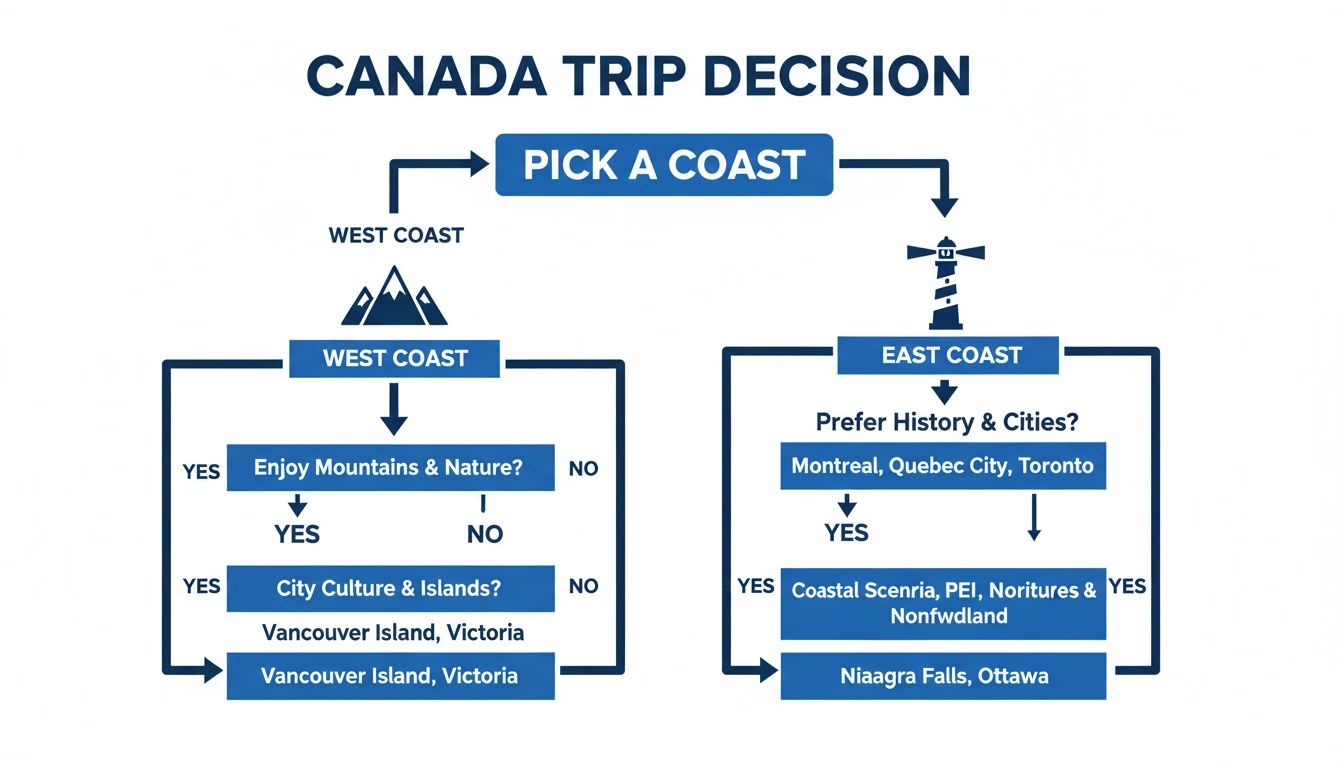
Before you think about destinations, ask yourself what kind of feeling you're after. Are you craving the profound silence of towering mountain ranges and impossibly blue glacial lakes? Or is it the salty air, lively fiddle music, and brightly painted fishing villages of the coast that calls to you?
Answering that one question immediately splits the country in half and makes your decision easier.
- Mountain Seekers & Grand Vistas: Your compass points West. This is the land of the Canadian Rockies in Alberta, the Sea-to-Sky Highway in British Columbia, and the untamed wilderness of the Yukon.
- Coastal Charm & Deep History: Head East. The Maritimes—Nova Scotia, Prince Edward Island, and New Brunswick—along with Newfoundland offer rugged shorelines, a palpable sense of history, and a pace of life that forces you to slow down.
This choice really comes down to dramatic, grand-scale nature versus intimate, story-rich culture.
A hard-learned lesson in the mountains
Last time I was out west, I attempted a "quick" drive from Vancouver to Banff. I looked at the map—850 kilometers—and budgeted one day, thinking I could just power through it. Big mistake.
What the map didn't show was a two-hour construction delay outside Revelstoke. It also didn't predict the complete standstill on the highway when a herd of bighorn sheep decided the warm asphalt was the perfect spot for a nap. My "quick" drive ballooned into a grueling 12-hour marathon. I rolled into Banff exhausted, irritable, and long after the sun had set.
The takeaway is simple: Your GPS is a liar. In mountainous or remote regions, always add at least 25-30% to any estimated drive time. Wildlife, sudden weather changes, and road work aren't possibilities; they're inevitabilities.
This isn't just about padding your schedule; it's about designing a trip that actually feels like a vacation, not a stressful logistics challenge. If this kind of detailed pacing feels a bit overwhelming, the WanderAssist 60-second planner is built to handle exactly this kind of reality-based scheduling for you. It's a great way to sidestep the decision fatigue that can derail a trip before you even leave home.
Route options by trip duration
To help you match your available time and travel style to the right part of the country, here’s a quick-glance table. It’s a starting point to see what’s realistically achievable.
| Region | Best For (Duration) | Vibe | Don't Miss | The Catch |
|---|---|---|---|---|
| BC's Sea-to-Sky | 3–5 Days | Adventure & Scenery | Whistler, Joffre Lakes, Sea-to-Sky Gondola | Can be very crowded, especially on summer weekends. |
| The Rockies | 7–10 Days | Epic Mountains & Wildlife | Icefields Parkway, Lake Louise, Moraine Lake | Requires advance booking for everything; expect traffic jams. |
| Vancouver Island | 7 Days | Coastal Rainforest & Laid-Back Towns | Tofino (storm watching!), Victoria, Pacific Rim | The ferry can be a bottleneck; book vehicle spots in advance. |
| The Maritimes | 10–14 Days | Charming Villages & Coastal Drives | Cabot Trail (NS), PEI National Park, Hopewell Rocks (NB) | You'll cover a lot of ground; don't underestimate drive times. |
| Québec | 5–7 Days | European Charm & French-Canadian Culture | Old Québec City, Montréal, Gaspé Peninsula | Language can be a barrier outside major cities if you don't speak any French. |
Think of this as your cheat sheet. Whether you have a long weekend or two full weeks, there’s an incredible Canadian road trip waiting for you—as long as you plan for the Canada that is, not the one on a pocket map.
What does a sustainable daily schedule actually look like?
Trying to cram too much driving into one day will absolutely tank a road trip through Canada. Those eight-hour stretches might look smart on Google Maps, but they're a recipe for burnout. You'll end up experiencing the country through a bug-splattered windshield, and that's not why you came.
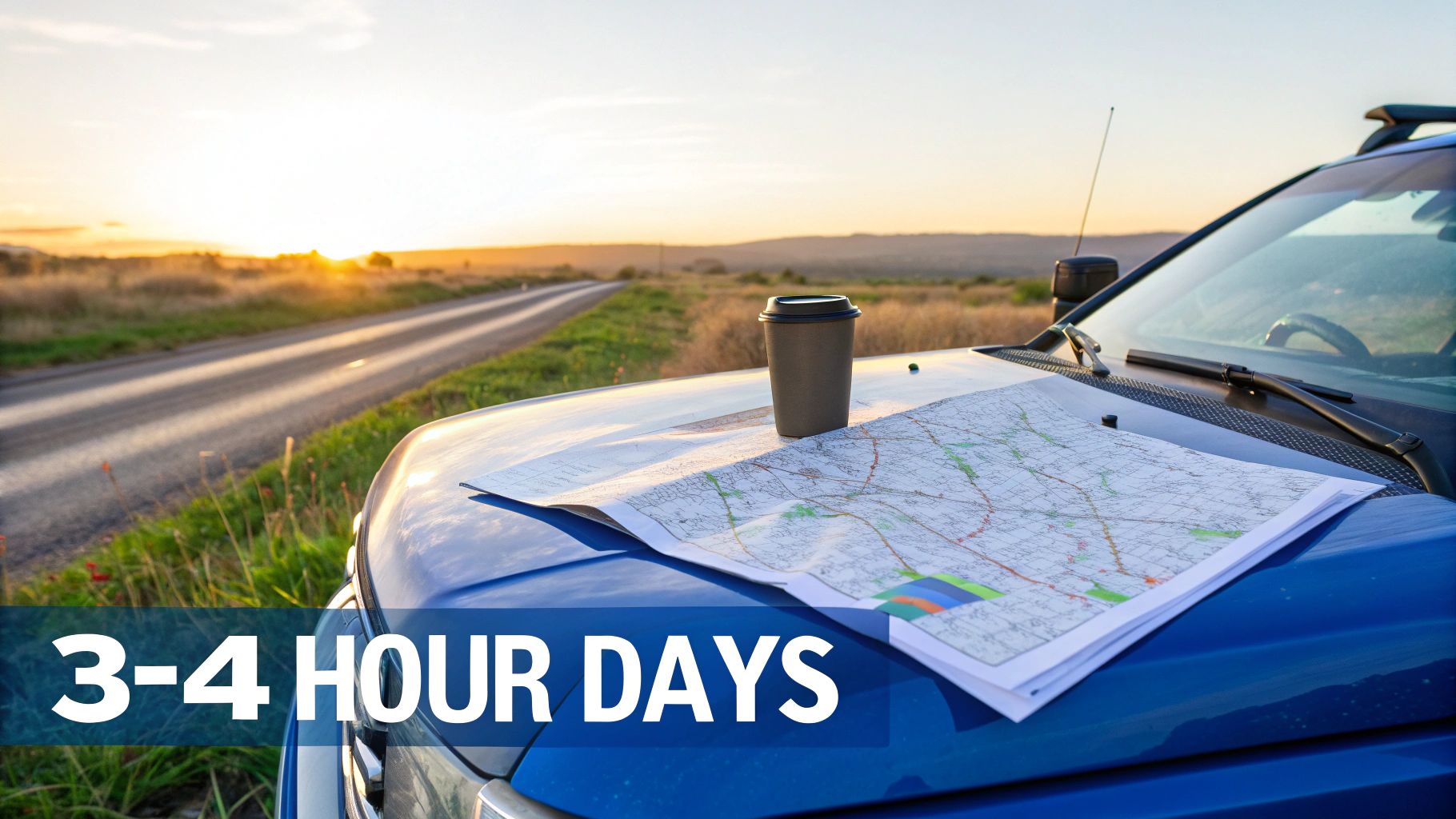
The sweet spot? Aim for three to four hours of actual driving per day. That’s the magic number. It feels counterintuitive, but it's smart planning. This pace leaves room for pulling over for a photo, taking a spontaneous hike, or simply waiting for a moose to finish crossing the road.
Timing Tip: How to use time and location to your advantage
A great Canadian road trip isn't just about what you see; it's about when and where you see it. Getting this right is the difference between a trip you endure and one you’ll talk about for years.
Take Moraine Lake in Banff, for instance. If you roll up at 10 AM expecting to park, you’re in for a rude awakening. That access road is often shut down by 6 AM because the lot is already full. The only people seeing that iconic turquoise water at its best are the ones who got there for sunrise.
This logic applies to entire routes, too. When you’re driving Nova Scotia’s Cabot Trail, going clockwise keeps the Atlantic on your side of the car, giving the passenger uninterrupted views. It also means you’re on the inside lane for those hairpin turns with steep cliff drops—a small detail that makes a big difference.
Neighborhood Anchoring: How to save money and sanity
Where you decide to sleep each night profoundly impacts your budget and overall experience. I call this neighborhood anchoring: picking one smart home base for a few nights instead of the constant grind of packing and unpacking every single day.
Here's what that looks like on the ground:
- Instead of pricey Banff town: Stay in Canmore. It’s just 20 minutes down the road, but the hotels and grocery stores are far more affordable. You get the same mountain access with a more local, laid-back vibe.
- Instead of staying right in Halifax: Find an inn in a smaller coastal town like Chester or Mahone Bay. You’ll get an authentic taste of Maritime life and still be close enough for a day trip into the city.
This approach encourages a slower pace. You spend less time in traffic, save money, and get a better feel for the region you’re exploring. If figuring out this strategic pacing feels overwhelming, a tool like the WanderAssist 60-second planner can bake these principles right into a realistic daily schedule for you.
Field-Tested Canada Road Trip Itineraries
Alright, enough theory. Let's get into what a well-paced, realistic Canada road trip actually looks like. These aren't just random lists of sights; they’re structured plans refined over time to cut down on backtracking and help you dodge the worst of the crowds. Think of them as a solid starting point you can steal and tweak.
I’ve learned the hard way that a great itinerary isn't about cramming everything in—it's about experiencing the right things at the right time.
Is a 3-day trip possible? Try the Sea-to-Sky Highway.
Perfect for a quick escape from Vancouver, this trip delivers a serious scenic punch without chaining you to the driver's seat. The absolute key here is timing your departure to avoid the gridlock at the Lions Gate Bridge.
- Day 1 Vancouver to Squamish (Drive: ~1.5 hours): Leave Vancouver after 9:30 AM on a weekday or before 8 AM on a weekend. Make your first stop at Porteau Cove for that classic Howe Sound viewpoint. Settle in Squamish. If you’re feeling ambitious, tackle the first peak of the Stawamus Chief; otherwise, the Sea-to-Sky Gondola gives you big views with way less effort.
- Day 2 Squamish to Whistler (Drive: ~1 hour): This is a short, beautiful drive that leaves your day open. Once in Whistler, I'd suggest skipping the main village bustle in the afternoon and heading for the calm of Lost Lake Park for a walk. Whistler is best late in the day after the day-trippers have cleared out.
- Day 3 Whistler to Vancouver (Drive: ~2.5 hours): Get in one last morning hike—the trail to Cheakamus Lake is a fantastic, relatively flat option. Start driving back to Vancouver mid-afternoon. This timing helps you miss both the Whistler checkout rush and the evening commute. Don't forget to stop at Brandywine Falls just south of Whistler; it's a quick walk from the parking lot.
How do you tackle the Rockies in 7 days?
This is the quintessential Canadian road trip, hitting the heavyweights of Banff and Jasper. I can't stress this enough: your success here is 100% dependent on early starts and booking your accommodation months—not weeks—in advance.
Price Warning: Getting a parking spot at iconic locations like Lake Louise and Moraine Lake is a competitive sport. For Lake Louise, be in the lot by 7 AM at the latest. For Moraine Lake, the access road often shuts down by 6 AM. Your best bet is to book a Parks Canada shuttle far in advance. Don't even think about winging it in high season.
- Days 1-2: Anchor in Canmore (from Calgary): It’s an easy 1.5-hour drive from Calgary. I recommend using Canmore as your base camp; it’s more affordable and far less chaotic than Banff. Spend your time exploring local trails like Ha Ling Peak or Grassi Lakes.
- Days 3-4: The Icefields Parkway to Jasper: The drive itself is only 3 hours, but you need to budget a full day for all the stops. Get an early start to see Peyto Lake and the Athabasca Glacier before the tour buses roll in. You’ll anchor in Jasper for two nights.
- Day 5: Explore Jasper: Get up for sunrise at Maligne Lake. Seriously. The crowds are non-existent, the light is stunning, and your chances of spotting wildlife are much higher.
- Day 6: Jasper to Calgary: This is a long haul back (~5 hours), so break it up. This is your opportunity to hit any viewpoints you missed on the way up the Parkway.
- Day 7: Departure from Calgary.
What about a 10-day Nova Scotia trip?
This trip is all about slowing down. It’s a journey through fishing villages, along rugged coastlines, and into a culture that feels a world away. This loop starts and ends in Halifax, making logistics simple.
- Days 1-2: Halifax & South Shore: Settle into Halifax. On Day 2, take a day trip to Peggy's Cove (go at sunrise if you want it to yourself) and then continue on to the picturesque towns of Mahone Bay and Lunenburg.
- Days 3-5: The Cabot Trail: Drive out to Cape Breton Island and find a spot to stay near Baddeck. You'll want to dedicate two full days to driving the Cabot Trail. My advice? Drive it clockwise. This keeps the ocean views on your side of the car. The Skyline Trail is popular for a reason, but try hiking it late in the afternoon for a chance at a sunset with fewer people around.
- Days 6-7: Bay of Fundy: Head towards the Bay of Fundy and set up base near Wolfville. You absolutely have to check the tide times. Seeing the world's highest tides at Hall's Harbour or Burntcoat Head Park is a mind-bending experience.
- Days 8-9: Eastern Shore: Now it's time to explore the less-traveled Eastern Shore. It's much wilder and more remote out here. Find a quiet spot, get out of the car, and just listen to the sound of the Atlantic.
- Day 10: Return to Halifax.
Trying to stitch all these details together from scratch can be a grind. If you're feeling a bit overwhelmed, our guide on how to create a travel itinerary offers a solid framework to get you started.
How do you handle the boring but critical details?
Alright, let's get down to the nitty-gritty. This is the stuff that isn't on the postcards but is essential for a smooth road trip. We're talking about the real-world logistics—money, paperwork, and safety—that can turn a dream vacation into a frustrating mess if you ignore them.
First, your budget. If you're coming from the US, the biggest sticker shock is almost always the price of gas. We sell it by the litre, not the gallon, and after you do the math (1 US gallon is about 3.785 litres), you'll realize it costs a lot more to fill up your tank here. Be honest with yourself about this expense, especially if you're driving a big SUV or RV through the mountains. It adds up fast.
Sorting out passes, permits, and insurance
You can't just roll up to Canada's national parks and expect to waltz in. For places like Banff, Jasper, or Pacific Rim National Park Reserve, you'll need a Discovery Pass from Parks Canada. Do yourself a huge favor and buy this online well before your trip. Trying to sort it out at the gate with a long line of cars behind you is a rookie mistake.
Next up is car insurance. Before you cross the border, you need to call your insurance provider. While most US policies extend coverage to Canada, you can't just assume it. Ask them for a "Canadian Non-Resident Inter-Province Motor Vehicle Liability Insurance Card." It's proof you're covered, it's free, and it will save you a massive headache if you get pulled over.
The secret to a great road trip is that 90% of it is boring prep work and only 10% is the actual adventure. Get the tedious stuff done first, and you'll be free to enjoy the drive.
The inevitable "wildlife jam" and why snacks are essential
I’ll never forget a drive along the Icefields Parkway when traffic just stopped. No accident, no construction. Just a huge herd of bighorn sheep that had decided the middle of the highway was the perfect place to hang out. We sat for the better part of an hour, engine off, just watching them.
It was a cool sight, but it was also a powerful reminder that you’re on nature’s schedule, not your own. That experience taught me two rules I now live by:
- Always have an emergency stash. I’m talking extra water, some protein bars, and a warm blanket. You might be a hundred kilometers from the next town, and a one-hour delay can easily turn into three.
- Learn to embrace the delay. Getting angry won't move a grizzly bear off the road. See it as part of the experience. Get out (if it's safe!), stretch your legs, and soak in the scenery.
It’s these little details that make all the difference. Taking the time to plan for them is what separates a stressful trip from an unforgettable one. If you're overwhelmed by the details, check out our guide on the best vacation planning apps for some tools that can help keep all your bookings in one place.
Burning Questions About Your Canada Road Trip
Planning a trip this big always brings up questions. I've been there. After countless trips across the country, I've heard them all. Here are the straight-up answers to the most common things people ask.
What's the best time of year to go?
Honestly, it all comes down to what you're after.
Summer (July and August) is classic for a reason. You get the best weather and long days perfect for hiking and paddling. The downside? Everyone else has the same idea. Expect peak crowds, high prices, and the need to book campsites and hotels months in advance.
My personal favorite time is early fall. Think September. The weather is still great, but the summer chaos has died down. Plus, if you're out east, the fall colors are spectacular. Spring (May-June) is a close second, especially for seeing waterfalls and, if you're lucky, icebergs floating off the coast of Newfoundland. Just be ready for some muddy trails.
Do I really need to book campsites ahead of time?
Yes. 100%. This is probably the most critical piece of advice I can give you.
For the big-name national parks—Banff, Jasper, Pacific Rim—campsites for July and August can sell out within minutes of the reservation window opening. I'm not exaggerating.
Showing up on a Friday afternoon in August without a reservation is a recipe for disaster. You'll spend hours driving around, stressed out, only to end up sleeping in a Walmart parking lot. Do yourself a massive favor: map out your route, know where you'll be each night, and be ready to book the moment reservations go live.
Can I drive my own car over from the US?
You bet. It’s the easiest way to do it. Just have your passport, driver's license, and vehicle registration ready for the border agent.
Here’s the pro tip: call your auto insurance company before you leave. While most US policies work in Canada, you need to confirm it. Ask them to send you a Canadian Non-Resident Inter-Province Motor Vehicle Liability Insurance Card. It's free, and it’s the official proof of coverage Canadian authorities want to see. Also, give your cell provider a ring to make sure you won't get hit with a monster roaming bill.
Is a winter road trip a good idea?
Unless you are a seasoned pro at driving in legitimate winter conditions, I would steer clear. I'm not talking about slush. I'm talking about whiteouts, black ice, sudden highway closures, and dangerously cold temperatures.
Many mountain highways, like those in BC and Alberta, legally require all vehicles to have proper winter tires or carry chains from October 1st to April 30th. Your average rental car won't have them. Save the winter trip for a specific ski adventure when you know exactly what you're getting into.
Feeling overwhelmed by all the moving parts? The WanderAssist 60-second planner was built to cut through this kind of planning chaos. It creates a realistic day-by-day schedule that won't leave you exhausted, so you can stop worrying and start exploring. You can generate your own custom plan here.