
Can an AI Travel Itinerary Actually Make Your Trip Better?

Discover how a modern AI travel itinerary avoids crowds and burnout. Learn the difference between a generic list and a realistic, time-blocked plan that works.
In short, yes—but only if it's "reality-aware." A genuinely useful AI travel itinerary isn't just a list of landmarks. It's a smart plan that groups activities by neighborhood and uses clever timing to help you dodge the worst crowds and avoid travel burnout. It feels less like a computer-generated list and more like a plan you'd get from a well-traveled local.
So, What's Wrong With Most AI Travel Plans?
Let's be direct. Asking a generic chatbot for a travel plan often gives you a glorified to-do list. You get a jumbled mess of famous spots that completely ignores the most crucial element of any trip: the flow. That chatbot has no idea that trying to get from the Colosseum to the Vatican at noon is a recipe for a miserable, exhausting day.
A genuinely useful AI travel itinerary, on the other hand, is built on a totally different foundation. It’s less about what you see and more about when and how you see it. The goal isn’t to pack as much as possible into a day; it's to make sure you can actually enjoy the things you do without feeling rushed.
This smarter way of planning is becoming the new normal. In 2025, a surprising 42% of global travelers used AI-powered tools to build their trips. That number jumps to over 60% for Gen Z and Millennials who are relying on AI for detailed, day-by-day schedules. The trend is clear: people are done with generic lists and want tools that give them practical, time-blocked plans. Discover more travel trends for 2026 on simon-kucher.com.
So, how does this work in practice? A reality-aware itinerary is built on two simple but powerful ideas:
- Temporal Logic: This is about timing. The AI knows when a place is packed and when it’s not. It might suggest you visit a popular museum late in the afternoon after the tour buses have cleared out, or swap a morning walk for an evening one to catch the sunset instead of the midday heat.
- Neighborhood Anchoring: This is about geography and saving your energy. Instead of sending you zig-zagging across a city and wasting time on transit, it groups your activities into walkable clusters. You explore one neighborhood at a time before moving on.
Let's break down the practical differences.
How do generic AI lists compare to reality-aware itineraries?
| Planning Aspect | Generic AI-Generated List | Reality-Aware AI Itinerary |
|---|---|---|
| Pacing & Flow | Random sequence of popular spots. | Logically sequenced days built around walkable neighborhoods. |
| Travel Time | Ignores travel time, leading to constant transit. | Minimizes transit by grouping nearby activities together. |
| Crowd Management | Sends you to hotspots during peak hours with everyone else. | Suggests visiting popular sites during quieter shoulder times. |
| Realism | An unrealistic checklist that often leads to burnout. | A practical, time-blocked schedule you can actually follow. |
| User Experience | Feels disconnected and overwhelming. | Feels intuitive, relaxed, and immersive. |
The difference is night and day. One approach leaves you feeling like you're just running through a checklist, while the other actually lets you sink in and experience a place. It’s this strategic thinking that separates a frustrating vacation from a truly memorable one. You can learn more about how a dedicated AI travel planner uses these principles to build better trips.
How Does an AI Actually Build a Smarter Travel Plan?
So, how does an AI travel itinerary go from a simple checklist to a genuinely smart plan? It’s not magic. It’s about teaching the AI to think more like an experienced traveler and less like a search engine.
Think of it as the difference between a grocery list and a recipe. One is just a collection of items, while the other is a step-by-step guide that considers timing and sequence to get the best result.
Last time I was in Paris, I wasted two full hours just getting from Montmartre to the Marais in the middle of the day. A smarter plan would have saved my feet and my sanity. This is exactly the kind of problem a reality-aware AI is built to solve. It doesn't just list attractions; it understands the city's rhythm.
The whole process boils down to two core concepts that make all the difference between a frustrating trip and a smooth one.
Does the AI understand timing?
Yes, and this is called temporal logic. It’s a technical-sounding term, but it just means the AI thinks about time. It chews through massive amounts of data on everything from crowd patterns and transit schedules to the average time people spend at a museum.
Imagine your planner knows the Louvre is a chaotic mess on Tuesday mornings but surprisingly calm on Wednesday evenings. Or that the metro is completely crushed at 5 PM on a weekday. A good AI travel itinerary uses this insight to slot your visit in for Wednesday evening, saving you from a sea of selfie sticks and a stressful commute.
How does it organize the day?
This is where neighborhood anchoring comes in. It's all about geography and good old-fashioned common sense. Instead of having you zigzag across the city all day long, it groups your activities into walkable districts.
So, you might spend your morning exploring the historic city center, grab lunch at a cafe there, and then pop into a nearby museum in the afternoon. This approach doesn't just save you hours on the bus or metro; it lets you really soak in the unique vibe of each area. You get to experience the city block by block, noticing the smells from local bakeries and the sounds of neighborhood life.
The WanderAssist Insight: The smartest travel plans aren't about cramming in the most sights. They're about experiencing places with the least amount of friction. By optimizing for time and location, an AI can eliminate up to 90% of the logistical headaches that lead to travel burnout.
This diagram shows how this process transforms a generic list into a plan that actually works in the real world.
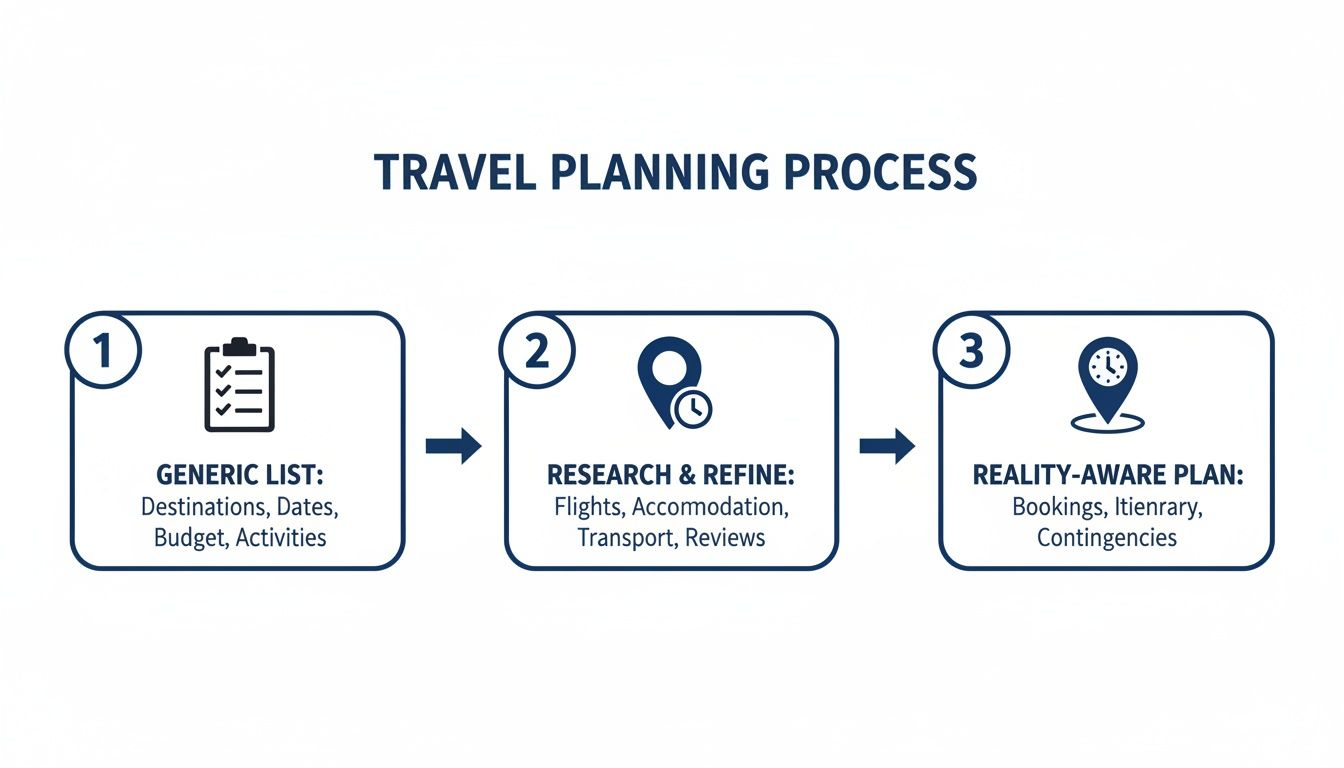
The key takeaway here is the shift from a passive list to an active strategy that respects real-world constraints like time and distance.
By weaving these two principles together, the AI constructs a day-by-day schedule that just flows. It’s not a random collection of data points; it’s a coherent story for your trip. This method moves way beyond basic recommendations to give you a plan that’s both practical and genuinely enjoyable, freeing you from that constant "what's next?" decision-making.
You can dive deeper into how an AI trip planner uses this logic to create better travel experiences.
Will an AI Plan Your Entire Trip Perfectly?
<iframe width="100%" style="aspect-ratio: 16 / 9;" src="https://www.youtube.com/embed/wc6IxU12eEU" frameborder="0" allow="autoplay; encrypted-media" allowfullscreen></iframe>Let's get right to it: an AI travel itinerary is a fantastic starting point, but it's not a magic button that spits out a flawless, hands-off script for your vacation. The idea that you can type one sentence and get your dream trip planned is marketing fluff. At the end of the day, your personal travel style and those moments of spontaneity are what make a trip great.
Think of a good AI planner as a savvy research assistant, not a replacement for your own judgment. Its job is to eliminate 90% of the tedious legwork—like figuring out travel times, opening hours, and logical routes—so you can focus on the fun stuff.
This approach is becoming the norm. By late 2025, an estimated 39% of active U.S. travelers were already using AI to research trips and piece together itineraries. While people are embracing the technology, they’re not letting it make all the decisions. They’re using it to get a solid framework, then making the final calls themselves. You can read the full research on how AI is changing travel planning.
Keeping a human in the loop is essential because, let's be honest, generic AI tools can get things spectacularly wrong.
What are the pitfalls of a "perfect" AI plan?
Many basic AI planners pull from outdated information, which leads to frustrating mistakes. They don't have a built-in "reality filter," which can create classic blunders that will derail your trip.
Here are a few I’ve seen time and time again:
- Physically Impossible Schedules: The AI might craft a day that looks perfect on paper but is a logistical nightmare, like scheduling a museum visit on the one day a week it’s closed.
- The Ghost Restaurant: It’s famous for recommending a highly-rated restaurant that, whoops, permanently shut its doors two years ago. We call these AI "hallucinations."
- Ignoring Local Context: It might send you to a major landmark on a national holiday, totally oblivious to the crushing crowds or holiday closures you'll face.
The WanderAssist Reality Check
The biggest myth is the "hands-off" AI plan. A specialized tool like the WanderAssist 60-second planner is designed to give you a logically structured, reality-aware draft. But it’s still your job to sanity-check it and make the small tweaks that make it your trip.
Price Warning: Be careful when booking tours or hotels directly through a generic AI suggestion. These tools don't always know which tour operators are reputable or which booking links offer the best price. Always double-check recommendations against recent reviews and, whenever possible, book directly with the provider to avoid inflated third-party fees. Your own judgment is the final, most important layer of a well-planned trip.
What Does a Reality-Aware Itinerary Look Like?
It's one thing to talk about smart planning in theory, but it’s another to see it in action. A useful AI travel itinerary doesn’t just throw a list of sights at you. It builds a day-by-day flow that works, understanding that a family with toddlers moves at a very different speed than a couple on a city break.
Let's look at a few real-world examples of how WanderAssist creates plans that feel crafted by a seasoned traveler, not an algorithm.

These aren't random suggestions. Every itinerary is built on temporal logic and neighborhood anchoring to save you from the exhaustion and decision fatigue that can ruin a trip.
Example 1: First-Time Couple in Rome
When you’re in Rome for the first time, the temptation is to cram everything in. A generic list would have you zig-zagging across the city. We take a smarter approach.
-
Neighborhood Anchor: Trastevere. We'd base the plan here. It’s walkable, filled with great restaurants, and has a local vibe that feels miles away from the tourist crush at night.
-
Temporal Logic in Action: The Colosseum is on everyone's list, but it becomes a furnace with soul-crushing lines by 11 AM. The AI knows this and books an 8:30 AM entry slot. This simple move gets you in and out before the peak crowds and the worst of the heat. The afternoon is then free for a much more relaxed wander through the shaded ruins of the Roman Forum next door.
-
Building in "The Linger Zone": Instead of rushing to another major landmark, the late afternoon plan might simply be: "Find a quiet piazza near Campo de' Fiori for an aperitivo." This carves out essential downtime, letting you actually soak in the city's atmosphere.
Example 2: Family with Kids in London
Traveling with little ones? The entire trip revolves around managing energy levels and avoiding public transport meltdowns. A generic AI won't get the nuances of traveling with a tired seven-year-old.
-
Neighborhood Anchor: South Kensington. This is a slam dunk for families. It puts you on the doorstep of two of the best kid-friendly (and free!) museums in the world.
-
Clustered Activities: The morning is dedicated to the Natural History Museum and the Science Museum. They are literally next door to each other, meaning there's zero travel time between them. This is a perfect example of how neighborhood anchoring can save a family’s day.
-
Scheduled Downtime: After a few hours of museum stimulation, the AI intelligently schedules a 90-minute break in Hyde Park. This isn't an afterthought; it's a planned activity. It means grabbing snacks, letting the kids burn off energy, and giving everyone a chance to recharge.
The WanderAssist Reality Check
A great itinerary anticipates burnout. For families, this means treating park time and snack breaks with the same importance as museum tickets. It’s all about creating a sustainable pace, not just ticking boxes.
Seeing these principles applied makes it obvious how a thoughtful AI itinerary goes far beyond simple lists. It's about crafting a travel experience that respects your time, your energy, and the on-the-ground reality of a busy city. This is the kind of strategic thinking that stops a vacation from feeling like a chore. And you can get a draft just like this in less than 60 seconds using the WanderAssist 60-second planner.
How Do I Get My AI Itinerary in 60 Seconds?
Alright, enough theory. The point of a smart AI travel itinerary is to slash the hours you'd spend staring at a dozen browser tabs. With WanderAssist, we've stripped it down to three simple steps that produce a realistic plan in about a minute.
No need to sign up or pull out your wallet. You can jump straight in and see what it can do.

What's the three-step process?
We designed this to be quick and intuitive. It's about generating a strong, practical draft that you can then fine-tune into your perfect trip.
-
Enter Your Destination and Dates: First things first, just tell us where you're headed and for how long. This lays the basic groundwork.
-
Select Your Travel Style: This is where you give the AI the real context it needs. Are you looking for a chill vacation, or are you a first-timer trying to see all the main sights? Your choice directly shapes the pace and density of the schedule.
-
Generate Your Plan: Click the button. That's it. In about 60 seconds, the planner crunches the data and spits out a day-by-day, time-blocked schedule that’s already been optimized for neighborhood anchoring and realistic timing.
The WanderAssist Insight: The first itinerary you get isn't meant to be set in stone. Think of it as the 90% solution. It does all the tedious logistical work—the routing, timing, and grouping—so you can focus on the final 10%, adding the personal touches that make the trip yours.
How do I customize my plan?
Once the draft is generated, making it perfect is just a matter of a few clicks. The real magic is how easily you can adjust the plan on the fly.
- Swap Activities: Not feeling a museum this morning? Swap it with an activity planned for the evening, and the planner will automatically adjust the surrounding times.
- Add Personal Notes: Got a hot tip from a friend about a hidden cafe? Add it as a note directly into that day's schedule so you don't forget.
- Delete What You Don’t Need: If a suggestion just doesn't resonate with you, get rid of it. This frees up time for spontaneous detours.
The goal here is to kill planning fatigue before it even starts. Get a great foundation, fast, and spend your time getting excited about the trip itself.
Ready to give it a shot? You can build your own reality-aware plan right now with the WanderAssist 60-second planner.
Is an AI Travel Planner Right for You?
It’s smart to be skeptical. The idea of letting an algorithm map out your vacation time can feel a bit odd. Let's tackle some of the most common questions.
Can I really trust an AI with my vacation?
Trust here isn't about blindly following a robot's commands. It’s about transparency. A good AI travel planner shows you its homework.
You can trust a plan when you see the logic behind it. For example, when it groups your activities in the same neighborhood to save you from an hour on the subway, that’s a suggestion you can trust. When it tells you to visit the museum in the late afternoon to sidestep tour groups, that’s a smart move based on data.
At the end of the day, an AI travel itinerary isn't a replacement for your own judgment. Think of it as a super-efficient research assistant. Its job is to solve the logistical nightmare of "what, where, and when," so you can focus on making the fun decisions.
Is this better than using a travel agent?
They're different tools for different jobs.
An AI itinerary planner is your secret weapon for instant, self-managed trip design. It's fast, affordable, and perfect for the traveler who wants a solid, logical framework for a city break or a road trip. It gives you structure, but you stay in the driver's seat.
A travel agent, on the other hand, provides a high-touch, personalized service that's indispensable for complex, once-in-a-lifetime journeys. They bring deep industry connections and handle all the bookings and human negotiations. One gives you structure and speed; the other provides white-glove service and human expertise.
What if my plans change last-minute?
This is where a digital AI plan leaves static tools like guidebooks in the dust. Travel is unpredictable. You might stumble upon a cool street festival, or a sudden downpour makes your planned hike a non-starter.
Tools like WanderAssist are built for this. A good AI itinerary is flexible. Need to swap activities? Just drag and drop. Decided to skip something? A quick tap and it's gone.
The WanderAssist Insight: Think of your AI itinerary as a living document, not a stone tablet. Its real power lies in the ability to edit your schedule in real-time, right on your phone. A sudden change of heart or a shift in the weather doesn't ruin your day—it just leads to a quick, two-second adjustment.
Spontaneous moments are often the best part of traveling. A smart planner doesn't just tolerate last-minute changes; it gives you a solid yet completely adaptable blueprint for your day. It keeps you in control, which is what independent travel is all about.
Tired of spending hours wrestling with maps and spreadsheets? WanderAssist builds a reality-aware, time-blocked itinerary in under 60 seconds, freeing you to focus on the trip itself. Get your smarter travel plan here.