
Is an AI Itinerary Planner Worth Using for Your Next Trip?

Discover how a modern AI itinerary planner can build a realistic, enjoyable trip. Learn to avoid common pitfalls and plan smarter, not harder.
An AI itinerary planner is supposed to create a travel schedule automatically based on where you’re going and what you like. Honestly, most of them just spit out a generic checklist of tourist traps, leaving you with a rushed, exhausting trip that feels more like a chore than a vacation. The best way to use one is to find a tool that builds a "reality-aware" itinerary, grouping activities by neighborhood to cut down on transit fatigue and suggesting specific times to visit to sidestep the worst crowds.
What Is an AI Itinerary Planner and How Does It Actually Work?
Remember the old way of planning a trip? A chaotic mess of endless browser tabs, crumpled maps, and conflicting advice from a dozen different travel blogs. I once tried to manually plan a trip to Lisbon, and it turned into a logistical nightmare.
I had us zig-zagging from Belém for pastéis de nata in the morning to the Alfama district for the castle in the afternoon, only to realize our dinner reservation was all the way back near Belém. We spent more time sweating on crowded trams than actually seeing anything. That feeling of exhaustion completely overshadowed the city's character.
This kind of travel burnout is exactly what a good AI itinerary planner is designed to prevent. It's not just a simple list-maker; it’s your personal logistics strategist. Instead of you spending hours figuring out if the museum is near the market, the AI does all that heavy lifting for you.
Does an AI planner really end planning fatigue?
Think of a basic planner as a simple recipe that just lists ingredients. A smart, "reality-aware" planner, on the other hand, is like an experienced chef. It knows how to combine those ingredients, in what order, and at the perfect time to create a solid meal.
It considers all the little details that we humans often forget until it's too late:
- Neighborhood Anchoring: It groups your activities into walkable clusters. So, you'll spend a day fully immersed in one area, like Trastevere in Rome, instead of wasting two hours on a bus just to see one thing across town.
- Temporal Logic: It knows the worst times to visit popular attractions. It won’t send you to the Eiffel Tower at midday on a Saturday. Instead, it might suggest an early morning visit or a late evening trip to avoid the peak rush.
- Pacing: It builds a schedule that feels manageable, not like a frantic race against the clock. A good plan should give you structure, but it shouldn't feel suffocating.
This shift toward smarter planning isn't just a niche trend. By 2026, a remarkable 63% of US leisure travelers are expected to use AI for most or every trip they take. And of the travelers who have already tried it, 96% plan to use it again for their next adventure, which shows it's solving a real problem. You can read the full research about these changing travel habits to see just how big this shift is.
This isn't about replacing the joy of discovery; it's about eliminating the logistical friction that gets in the way of it.
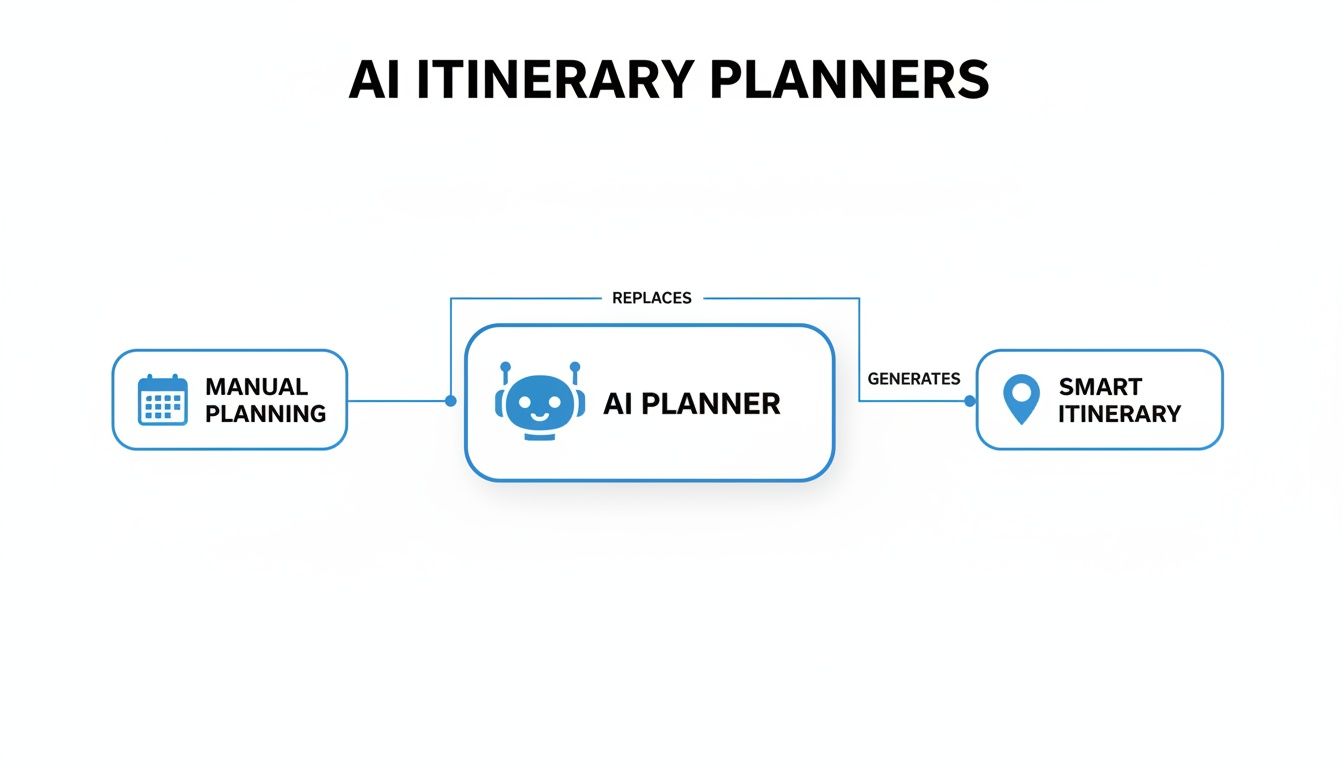
How does manual planning compare to using an AI?
So, how does stacking up hours of manual research compare to letting an AI do the hard work in seconds? Let's break it down. While both can get you a plan, the process and the final result are worlds apart.
| Planning Aspect | Manual Planning (The Old Way) | AI Itinerary Planner (The Smart Way) |
|---|---|---|
| Time Investment | 10-20+ hours of research, mapping, and booking. | 5-15 minutes for a complete, optimized first draft. |
| Effort & Stress | High. Juggling tabs, maps, and reviews is mentally draining. | Low. Answer a few questions and let the AI handle the complexity. |
| Logistics | Prone to errors. Inefficient routes and poorly timed visits are common. | Geographically and temporally optimized. Activities are clustered logically. |
| Personalization | Based on generic blog posts or your own limited knowledge. | Highly personalized based on your specific interests, budget, and travel style. |
| Flexibility | Rigid. Making a change can cause the entire plan to unravel. | Instantly adaptable. Add, remove, or change plans on the fly. |
| Discovery | You might miss spots that aren't on the top 10 lists. | Uncovers unique spots and local favorites you might have never found. |
Ultimately, manual planning gives you total control, but at a steep cost of time and stress. An AI planner gives you a massive head start, handling the tedious logistics so you can focus on the fun part: looking forward to your trip.
How Do AI Planners Actually Build Your Itinerary?
Let's get one thing straight: an AI itinerary planner isn't running on magic. It’s a data-processing powerhouse, but the way it crunches that data is what separates a genuinely helpful tool from one that just creates a logistical nightmare for your vacation.
The most basic AI planners act like a lazy researcher. They scrape the web for the most popular landmarks, restaurants, and attractions and just spit them out in a list. This is exactly how you end up with nonsensical plans suggesting you crisscross a sprawling city like Paris three times in one afternoon. It’s a checklist, not a real strategy.
A smarter system, on the other hand, uses a much more sophisticated, layered approach. It's less like a simple web scraper and more like a seasoned local who actually understands the rhythm and flow of their city.
What's the logic behind a smarter plan?
A truly effective AI doesn't just ask "what" to see, but "how" and "when." It operates on two core principles that help you avoid the classic tourist trap: a schedule that looks great on paper but is physically impossible to follow.
- Neighborhood Anchoring: This is a simple but crucial idea—grouping activities by location. Instead of treating a city like a random assortment of pins on a map, the AI divides it into walkable districts. You get to spend your time exploring one area deeply, which cuts down on travel fatigue and lets you truly soak it all in.
- Temporal Logic: This is all about timing. The AI crunches historical crowd data, opening hours, and average visit durations to figure out the best time to go somewhere. It knows that visiting the Colosseum at 1 PM in July is a fundamentally different (and much worse) experience than going first thing in the morning.
This flowchart illustrates the difference between a basic AI’s chaotic output and a smart, reality-based itinerary.
As you can see, the smarter AI acts as a filter, transforming a jumble of ideas into a logical, enjoyable route. This simple step prevents the burnout that so often comes from a poorly structured day.
How does an AI turn raw data into a real plan?
Here's an analogy. A basic AI planner is like a novice cook who just throws popular ingredients into a bowl. They know people like chicken, tomatoes, and pasta, so they dump them all together. The result might be edible, but it’s certainly not a meal you’d remember.
A sophisticated AI, like the engine behind the WanderAssist 60-second planner, is more like a professional chef. It understands that the order and timing of those ingredients are what really matter.
It knows you have to sauté the onions before adding the garlic, that you let the sauce simmer to develop flavor, and that the pasta needs to be cooked al dente. It uses the same popular "ingredients" but combines them in a way that creates a cohesive, deeply satisfying experience.
That’s the fundamental difference. One gives you a list; the other gives you a plan. One sets you up for a frantic scramble across town, while the other builds a realistic schedule that respects your time and energy.
You can learn more about how a well-structured AI trip planner can reshape your entire travel experience. Ultimately, the goal isn't just to see things—it's to actually enjoy the process of seeing them.
What Separates a Good AI Planner from a Bad One?
Let's be honest. Every AI planner out there promises to make your life easier, but the reality is that many of them just spit out a pretty-looking schedule that’s actually logistical chaos. They're great at pulling a list of famous sights, but they're often terrible at creating a plan that a real person can follow without ending up completely exhausted.
So, how do you tell the good from the bad?

A good AI itinerary planner gets that your energy isn't limitless. It prioritizes a sensible pace and real-world logistics over simply checking boxes. A bad one, on the other hand, will have you zig-zagging across a city just to cram one more thing in, completely ignoring the hours you’ll waste just getting from point A to point B.
This is a huge and rapidly expanding space. The market for generative AI in travel is projected to skyrocket from USD 1,265.18 million in 2026 to a massive USD 5,788.55 million by 2035. That growth is being driven by tools that actually work—one planner, for instance, managed to create 40,000 genuinely useful itineraries on its very first day. Discover more insights about the rapid growth of AI in travel.
Is the AI planner focused on pace or points?
The single biggest tell between a helpful tool and a useless one comes down to its core philosophy. A bad planner is obsessed with "points of interest," trying to jam as many as it can into a single day. A good one focuses on pace, crafting a schedule that feels manageable, flexible, and, most importantly, fun.
This means the best tools intentionally create breathing room instead of just packing every available minute.
- "Linger Zones" Not Timed Stops: A smart planner won't just give you a list of stops. It will point you to neighborhoods perfect for wandering, like Le Marais in Paris or Trastevere in Rome, and encourage you to get lost for an hour instead of rushing to the next pin on the map.
- Context Over Clichés: A bad planner serves up generic fluff like "enjoy impressive views." A great one gives you sensory details you can actually use: "Go at 8 AM, and you'll smell the bakeries opening as you walk."
- Expectation Correction: It should give you the unvarnished truth. Knowing why it suggests visiting the Louvre on a Wednesday evening is far more valuable than just seeing its opening hours listed.
What are the essential features of a reality-aware planner?
When you’re looking at different AI itinerary planners, ignore the shiny marketing and focus on these practical, must-have features. These are what make the difference between a trip that flows and one that falls apart.
The goal isn't just to see things; it's to experience a place without the constant stress of feeling like you're falling behind schedule. A good planner gives you structure, not a straitjacket.
A truly helpful tool should deliver on these three things:
- Logical Neighborhood Grouping: This is absolutely non-negotiable. If a planner suggests visiting three attractions on opposite sides of a city in one day, close the tab. It fundamentally misunderstands how travel actually works.
- Intelligent Time-Blocking: It has to give you a realistic estimate for each activity that includes the travel time between them. Any plan that doesn't account for that 30-minute metro ride is just setting you up to fail.
- Transparency and Reasoning: The best tools don't just tell you what to do; they tell you why. A simple note like, "Visit the Pantheon at 9 AM to avoid the midday heat and the worst of the crowds," shows it’s making smart, strategic choices, not random ones.
Not long ago, I was testing a planner that suggested a 45-minute boat tour, a museum visit, and a hike—all in a single afternoon. It completely ignored the travel time, the lines, and the simple fact that a human would be wiped out. That's the kind of digital brochure you need to steer clear of. If decision fatigue is setting in, the WanderAssist 60-second planner is the solution.
Can You Really Trust AI Travel Recommendations?
Let's get straight to the point: can you actually trust a machine to plan your vacation? The answer isn't a simple yes or no. It really boils down to what that machine has been taught. A lot of AI planners are basically fed a digital diet of old reviews, sponsored blog posts, and user opinions that are easy to game.
This is a massive problem. A tool that just scrapes whatever it finds online can't tell the difference between a genuine local favorite and a restaurant that's just fantastic at marketing. It has no way of knowing that the five-star café it's suggesting is actually a tourist trap that will charge you €7 for a coffee.
What's the problem with the data AI planners use?
The real issue is whether the AI is built to value subjective opinions or hard, objective data. A huge number of positive reviews doesn't always mean a place is good; it often just means it's popular. A genuinely useful AI, on the other hand, pieces together objective facts—things like opening hours, actual travel times between spots, and data on when crowds are at their worst—to build a plan that won't fall apart in the real world.
Think of it like this:
- Subjective AI: This is like an easily swayed friend who just recommends whatever is currently trending online.
- Objective AI: This is more like a savvy logistical expert, focused on making your day efficient and hassle-free.
This distinction makes all the difference. Last year, I was testing a generic AI planner for a trip to Florence, and it confidently suggested a "highly-rated" trattoria for dinner. When I got there, I found a long line of tourists, menus printed in five different languages, and pretty forgettable food. The AI had just pulled review scores without any context.
Why is a logistics-first approach more trustworthy?
Frustrated, I tried a different tactic the next night. I looked for well-regarded places within a 10-minute walk of my hotel, checked them against a few local food blogs (not the big-name review sites), and found a tiny osteria tucked away on a side street. The experience was night and day: no line, incredible food, and the comforting sound of Italian being spoken all around me.
That's precisely the kind of discovery a logistics-first AI can help you make. It’s not about finding the absolute "best" place in a city, but finding the best place for you, right now—one that fits neatly into your schedule and helps you sidestep the usual travel friction.
The trust issue with AI recommendations isn't about how smart the AI is. It's about what data it's been taught to prioritize. An AI that understands your time is more valuable than a generic five-star rating is an AI you can actually rely on.
This shift toward trusting an AI's logistical brain is already well underway. Younger travelers are embracing the ai itinerary planner in a big way, with over 60% of Gen Z and Millennials now using AI for everything from travel inspiration to building full trips. In fact, a recent analysis found that 94% of users trust AI recommendations just as much as, or even more than, traditional sources like Google and review aggregators. You can explore how younger travelers are redefining digital discovery with these tools.
Ultimately, the right kind of AI acts as your personal travel strategist. It takes care of the tedious stuff—the routing, the timing, the crowd avoidance—freeing you up to make the fun, spontaneous discoveries yourself.
How Can You Create a Realistic Plan in Under 60 Seconds?
Okay, enough of the theory. Let's walk through how a smart AI itinerary planner can put together a solid, doable plan in less time than it takes to make a cup of coffee. We're not talking about a rigid, minute-by-minute schedule. The goal here is to create a strong logistical foundation—a starting point you can actually use without running yourself ragged.
It all boils down to a simple process. You tell it where you're going, for how long, and what your vibe is. That’s it. No more drowning in a sea of browser tabs.
How does it go from clicks to a cohesive plan?
Let's say you're planning a quick three-day trip to Rome. All you need to provide is:
- Destination: Rome, Italy
- Duration: 3 Days
- Travel Style: A mix of history and local culture
This is where the good stuff happens. The AI doesn't just spit out a list of famous landmarks. Instead, it uses what I call "neighborhood anchoring" and temporal logic to create a plan that makes sense on the ground. It crunches thousands of data points—opening hours, typical visit durations, and walking distances between sites—to save you from common rookie mistakes.
The result is a first draft that's already miles ahead of a blank notebook.

Look closely at how the days are structured. Day 1 is centered on Trastevere, a walkable district full of narrow streets and local shops. Day 2 is all about the ancient heart of the city, keeping the Colosseum and Roman Forum together. This kind of logical grouping instantly gets rid of the frustrating, time-wasting treks across town that can really drain your energy.
Is the AI's first draft actually usable?
The real win is in the details that manage your expectations before you even pack your bags. For example, the plan won't just say "visit the Pantheon." It’ll suggest going at 9 AM to beat the notoriously long lines. That's not a lucky guess; it's a practical tip based on real-world crowd data.
A good plan doesn't just tell you what to see. It tells you how and when to see it to avoid the worst of the crowds, the heat, and the general exhaustion that comes with poor timing.
This approach hands you a structured, sensible framework from the get-go. It handles all the tedious logistical heavy lifting, freeing you up to add your personal touches. Don't feel like visiting a particular museum? Just remove it. Found a restaurant you’re dying to try? Slot it in. The solid logistical backbone is already in place, so you’re never starting from a blank page.
Getting your first draft is incredibly straightforward. Here’s a quick look at how you can get started with WanderAssist.
Your First 3 Clicks to a Better Trip with WanderAssist
| Step | Action | What It Achieves |
|---|---|---|
| 1 | Enter Your Destination | Tell the AI where you're going. This sets the geographical foundation for your entire trip. |
| 2 | Select Your Dates & Duration | Input how many days you'll be there. This defines the timeline and pace of the itinerary. |
| 3 | Choose Your Travel Style | Pick your interests (e.g., "Foodie," "History Buff," "Relaxed Pace"). This tailors the suggestions to what you actually enjoy. |
That’s all it takes. The system takes these three simple inputs and builds a comprehensive, reality-aware itinerary.
If you want to stop the endless research and get a solid plan in your hands, you can generate your own reality-aware itinerary with WanderAssist in less than a minute.
The WanderAssist Reality Check
Here’s the part most travel blogs and every overly optimistic ai itinerary planner seems to gloss over. The biggest trap with automated planning isn't just getting a clunky route; it's the quiet assumption that you have infinite energy, a bottomless budget, and that travel always goes smoothly. It doesn't factor in tired feet, jet lag, or the gut-punch of tourist pricing.
This is the dose of reality you need before you go. An AI can spit out a schedule, but it can’t prepare you for the real-world friction of travel. Without that honest context, a plan that looks perfect on paper can quickly unravel on the ground.
Price Warning: The Tourist Tax Is Real
Let’s talk money. That picture-perfect café with a direct view of the Eiffel Tower? It's going to hit you with a €7 bill for a pretty average coffee. The truth is, just three streets over, you'll find a local spot with far better coffee for €2, where you’ll hear the clatter of actual ceramic and snippets of local conversation instead of a dozen other tourists snapping the same photo.
An AI planner is brilliant at finding popular places, but it’s clueless when it comes to spotting these inflated prices. It won't tell you the souvenir shop right next to the main attraction is selling the exact same stuff as a store ten minutes away for double the price. My rule of thumb? Always assume that prime-location convenience comes with a hefty markup. Before you sit down to eat or drink, just walk a few blocks away from any major landmark. Your wallet will thank you.
Tourist Trap Alert: The Sunset Cruise Myth
So many AI-generated plans will suggest a romantic river cruise at sunset. It sounds good, right? But here’s what that actually looks like: you'll be crammed onto a boat with 200 other people, all fighting for the exact same sunset photo. Instead of a peaceful moment, you get a chaotic shuffle for elbow room.
The best experiences are rarely the ones advertised to everyone. True travel satisfaction comes from sidestepping the crowds, not joining them.
A much better approach? Find a riverside park or a quiet bridge away from the main boarding docks. Bring your own drink, find a bench, and watch those jam-packed boats float by. You’ll get the same incredible view, a better photo, and none of the frustration.
This is exactly why a simple list of attractions just doesn't cut it. You need a plan that understands the crucial difference between what's popular and what's actually enjoyable. The goal isn't just to see a city—it's to experience it without feeling like you're just another customer on a conveyor belt. It’s all about building a smarter trip, not just a busier one.
Frequently Asked Questions
You've got questions, and we've got straight answers. This isn't the place for vague promises; it’s about clearing up the common uncertainties around using an AI itinerary planner so you can decide if it's the right tool for your next trip.
Is an AI Itinerary Planner Free to Use?
Many offer some kind of free version, but let's be honest: the quality is all over the map. A lot of the free tools just spit out a generic, often impractical, list of popular spots. It’s a classic "you get what you pay for" scenario.
Some platforms, however, focus on delivering real value upfront. The WanderAssist planner, for instance, lets you generate a complete, reality-aware itinerary for free without even asking for your email. The idea is to prove its logistical value right away.
Paid tiers on other platforms might unlock more advanced customization or collaboration features. But my advice? Always stress-test the free version first. If its core planning logic sends you on a wild goose chase across the city, paying for it will just give you a more expensive wild goose chase.
Can I Customize the Itinerary an AI Creates?
You absolutely should. A good AI-generated itinerary is meant to be a strategic starting point, not a rigid set of commands to follow. The last time I was in Paris, the plan gave me a solid route through Le Marais, but I swapped out a recommended museum for a small bookstore I’d heard about. The structural integrity of the day remained, but the experience became uniquely mine.
The best planners make this easy. You should be able to delete activities you don’t care about, add your own finds, and adjust timings with a simple click.
Think of the AI as an expert assistant who handles the tedious work—the routing, timing, and crowd logistics. That frees you up to focus on the fun part: tailoring the plan to what you actually want to do.
Will AI Planners Make Travel Agents Obsolete?
Nope, they serve different purposes. They aren't in direct competition; they solve different problems for different kinds of travelers.
An AI itinerary planner is the perfect tool for independent travelers who want a solid, efficient framework for city breaks or road trips. It excels at logistical optimization for a single destination.
A human travel agent, on the other hand, is invaluable for truly complex, multi-country journeys, high-end luxury travel, or trips that require deep, specialized knowledge (like planning a remote safari). AI is making expert-level logistical planning accessible to everyone, but it’s not replacing the high-touch, personalized service of a great agent.
How Do AI Planners Handle Spontaneous Travel?
This is a key point that separates a good planner from a bad one. A poorly designed tool will cram your schedule full, leaving zero room for the happy accidents that make travel memorable. It turns your vacation into a checklist.
A "reality-aware" planner does the opposite by intentionally building in flexibility. It creates a solid logistical anchor for the day but also suggests "Linger Zones"—neighborhoods like Trastevere in Rome or El Born in Barcelona that are perfect for aimless wandering.
This gives you structure where it matters (like pre-booking a ticket for a wildly popular museum) but complete freedom where it counts. You can stumble upon a local market or follow the sound of music down a side street without feeling like you've fallen "off schedule." It’s the best of both worlds: a plan that keeps you on track without boxing you in.
Tired of the planning fatigue and ready for a trip that feels less like a checklist and more like an experience? The WanderAssist 60-second planner builds a reality-aware itinerary that prioritizes pace over points, so you can stop stressing and start exploring. Generate your free, logistics-first itinerary now.